

Loving horses isn’t enough. In today’s world, doing more than just liking horses is key. Good intentions are just the start.
What makes someone a true advocate? It’s the difference between just knowing about something and really understanding it. Going to one clinic is like eating fast food for your horse’s soul. It might feel good at first but lacks real value.
Real change needs a solid plan. Programs like the 360 Horse Welfare Workshops offer deep learning through monthly classes. Equuvation helps build skills with a structured approach, from EAL to understanding a horse’s life cycle. It’s not about getting awards; it’s about gaining knowledge.
HETRA’s “Strides Forward” workshop shows how important topics like leadership are. “Advocacy is a skill you can learn.” It requires education, like what you find in a catalog of equine workshops. This series turns passion into real power.
This is what’s needed to go from just wanting to help to being a true advocacy training expert.
Curriculum Development for Multi-Session Programs
If your workshop series feels like a mix of unrelated songs, you need a better plan. Just throwing facts at people doesn’t work. It’s like educational confetti that’s colorful but messy. Real learning needs a clear plan.
Think of curriculum development as a blueprint for your educational project. Without it, you’re just piling up blocks randomly. Successful programs are carefully planned, not just thrown together.
Equuvation’s JR.EQ. EAL framework is a great example. It teaches horsemanship in a story-like way. It starts with LEARN, then CONNECT, BELONG, REACH. This approach mirrors how we learn best.
HETRA’s workshop agenda shows how to pace learning well. Day one is gentle, building trust. By day two, they’re ready for more complex tasks. This is not by chance; it’s well-planned.
360 Horse Welfare takes a monthly approach. Each session focuses on a specific topic, yet they all connect. Emotional intelligence in month one helps with facility design in month four. This scaffolding effect makes education memorable.
| Organization | Program Structure | Core Progression Principle | Session Count |
|---|---|---|---|
| Equuvation | JR.EQ. EAL Framework | LEARN → CONNECT → BELONG → REACH | 4-phase sequential |
| HETRA | Two-Day Intensive Workshop | Foundation → Application → Mastery | 2 days, progressive modules |
| 360 Horse Welfare | Monthly Series | Discrete topics with cumulative skill building | 4+ months, thematic progression |
| Ideal Curriculum Design | Multi-Session Arc | Why → What → How → Apply | 3-6 sessions minimum |
The table shows the key to success: sequential learning paths. Each model starts with “why,” then “what,” then “how,” and ends with “apply.” This creates a clear path to expertise.
Why is this important for horse care workshops? Without structure, inspiration fades quickly. Participants leave excited but without a plan. A well-designed curriculum gives them that plan.
Skill building needs repetition and variation. Start with theory, then apply it, then solve real problems. Each step builds on the last, adding complexity.
The magic happens in the transitions between sessions. That’s where learning really sticks. Participants connect yesterday’s theory with today’s practice, building lasting mental models.
Think about your own program. Does each session feel like a new chapter, or just random? The former keeps people engaged; the latter leads to boredom. Your curriculum should make participants look forward to the next session.
Remember, people remember stories, not just facts. Your curriculum is their story of growing expertise. Design it with a clear story arc, character development, and a satisfying end. That’s how you turn casual attendees into true advocates.
Basic Horse Care Workshop Design
The biggest change in horse education is not in advanced seminars. It’s in rethinking what ‘basic care’ means. We’ve moved beyond just feeding and watering. Today, advocacy training gets hands-on.
The 360 Horse Welfare Workshops model is a key example. It focuses on understanding horses’ emotional intelligence. This isn’t just theory; it’s about reading signs like ear flicks and tail swishes.
This skill is essential. It helps people recognize and solve problems before they start. It also questions the need for shoeing horses, asking if it’s for their good or ours.
Equuvation’s Lifecycle of the Horse (LOTH) program takes this thinking further. It views every grooming session and hoof pick as part of the horse’s life story. This approach ensures the horse’s health from breeding to retirement.
This way of caring is not just basic; it’s moral. The LOTH program teaches us to think long-term. It turns daily tasks into parts of a bigger story, which is key for advocates.
HETRA’s “The Weight of Responsibility” session tackles tough policy issues. It’s about weight limits and their ethical weight. This is basic math with big moral implications.
A workshop that avoids these topics isn’t teaching care. It’s teaching to follow rules without question. HETRA shows that real advocacy training means standing up for what’s right, even when it’s hard.
So, what’s the plan? Ditch old ways and start with the horse’s experience. Use facts, not tradition, to guide us. Frame each task in the horse’s life story. And teach people how to have tough conversations.
The goal isn’t to make perfect caretakers right away. It’s to change how we think. To move from passive owners to active stewards who question the status quo. This is the heart of advocacy training. It starts with a simple tool like a weight tape and the courage to use it.
Advanced Advocacy Skills Training
Knowing the difference between a P3 and a navicular bone is basic horsemanship. But convincing a CFO it’s a priority is advanced advocacy. This is where the heart meets the spreadsheet.
Think of it as boardroom jujitsu. It’s the strategic skill of using an opponent’s momentum to advance your agenda. HETRA’s curriculum focuses on “Managing Tough Conversations” and “The Horses’ Advocate.” The goal is to strategize smarter, not shout louder.
So, what does this skill building actually look like? It starts with a brutal reframe. You must stop seeing equine welfare as an expense. Instead, present it as a non-negotiable asset.

HETRA’s genius is using horses to teach this shift. Their equine-assisted learning activities are not about grooming. They’re exercises in self-regulation and perspective-taking. You learn to read the subtle cues of a 1,200-pound animal.
The real work is in the translation. Can you take your passion and turn it into a boardroom-ready proposal? This involves specific tactics:
- Conflict Navigation: Not avoiding disagreement, but steering it toward productive outcomes. Address the fear, not the insult.
- Stakeholder Diplomacy: Identifying everyone with a seat at the table and crafting a message that resonates with each group’s values.
- Budget Alchemy: Transforming welfare needs into value propositions. A new footing material isn’t just an expense; it’s an investment in animal longevity and program safety.
This advanced training ensures the horse has a seat at the table. It’s the dark art of making a compelling case. Making welfare the obvious, smartest business decision in the room is the ultimate advocacy skill.
Guest Expert Recruitment Strategies
Recruiting guest experts for your workshop series is more than just filling slots. It’s about creating a team of experts for horse welfare. You need a carefully chosen group, not just anyone to talk.
360 Horse Welfare uses experienced equine professionals, veterinarians, and ethologists. They understand horse behavior. Equuvation brings in licensed therapists and PATH Intl. certified professionals. HETRA’s panel includes Certified Therapeutic Riding Instructors and occupational therapists. This mix of experts makes your workshop better.
To build your team, first figure out what you need. Do you need more on care or psychology? Your gaps should guide who you recruit.
The table below shows the types of experts, their value, and how to find them. It’s like a cheat sheet for your casting director.
| Expert Type | Core Value to Workshop | Key Recruitment Consideration |
|---|---|---|
| Veterinarian | Provides medical authority and debunks common health myths. Essential for basic care modules. | Seek those who enjoy teaching. A brilliant surgeon who can’t explain concepts is useless for your goals. |
| Equine Ethologist | Adds behavioral science credibility. Explains the “why” behind horse actions, moving beyond folk wisdom. | Find researchers who translate data into stories. Their job is to make science accessible, not intimidating. |
| Licensed Therapist (OTR/L) | Bridges the human-equine intersection. Crucial for workshops on equine-assisted services or advocacy psychology. | Look for professionals experienced in community education, not just clinical practice. |
| Certified Instructor (PATH Intl., CTRI) | Offers practical, hands-on methodology. Grounds theory in actionable barn-floor techniques. | Prioritize communicators who can break complex skills into learnable steps. |
| Equine Manager/Specialist | Brings daily management reality. Answers the “how do we actually do this?” questions with real-world logistics. | Recruit from respected facilities. Their war stories and practical tips are gold. |
The pitch for experts is key. Don’t just ask for a “lecture.” Frame it as a chance to shape a movement. Experts are busy, so make your offer clear.
Once they agree, start the briefing. Make sure they know what to expect. Give them info on your audience. This helps them tailor their message. Encourage them to tell stories, not just lecture.
Each expert adds a unique view to volunteer education. A vet talks about hoof care, an ethologist explains stress signals, and a therapist explores emotional impact. This mix is powerful.
Your role is to make sure each expert fits with the others. When done right, a guest spot becomes a key part of your educational story. It builds authority, fosters deep learning, and inspires your audience. This turns your workshop into a cornerstone of volunteer education.
Creating Safe Learning Environments
The most advanced skill building in horse welfare starts with a simple rule: the right to be wrong. Forget about the helmet waiver for now. The real safety rule is about feeling okay to ask questions, even if they seem silly.
True safety is about feeling safe in your mind. It’s the base of all learning. Without it, you’re just going through the motions, not really learning.
HETRA’s session on “Managing Stress for Sustainability” teaches us a key fact: stress spreads easily. A leader’s calmness sets the mood for everyone. If you’re stressed, the horse might see you as a threat. If you’re in a rush, your students will feel judged.
Your main skill isn’t just knowing the material. It’s keeping everyone’s stress levels down. This is when deep learning can happen.
360 Horse Welfare suggests creating environments that are good for both the mind and body. It’s not just about the size of the stall. It’s about having clear views, regular routines, and gentle handling for the horse.
A calm horse makes the handler feel less anxious. It’s a positive cycle. You’re not just building a place; you’re creating a calm environment for everyone.
Equuvation’s MIND/FULL workshops and Nature-based OT models show this idea clearly. They focus on safe, welcoming, and non-judgmental spaces. Why? Because safety lets us be open. And being open is the only way we can really learn new things.
So, how do you create this safe space? It takes careful planning in two areas.
| Aspect | Physical Space Design | Conversational Space Design |
|---|---|---|
| Foundation | Predictable routines, clear equine body language signage, safe horse-handling zones. | Explicit ground rules set by the group, a “no dumb questions” mantra, facilitator modeling of curiosity. |
| Atmosphere | Quiet, clutter-free learning areas; access to water/rest for humans and horses. | The facilitator’s calm demeanor; use of humor to defuse tension; permission to step back and observe. |
| Feedback Loop | Observing equine relaxation signals (licking/chewing, lowered head) as positive indicators. | Active listening by the facilitator; validating participant observations without immediate correction. |
| Outcome | Reduced equine anxiety, leading to safer hands-on practice. | Increased participant vulnerability, enabling genuine skill building and behavioral change. |
This approach turns your workshop into a real change experience. It matches the idea of creating environments filled with safety and belonging. When people feel safe, they learn more. When they feel they belong, they care more.
The facilitator’s best tool isn’t a fancy presentation or a special halter. It’s the consciously crafted space—both physical and conversational—where fear fades away. That’s not just planning a workshop. That’s building a safe space for growth.
Certification Program Development
Creating a certification for horse care workshops is about quality control, not gatekeeping. It’s a way to separate the serious from the weekend warriors. A good credential acts as a bullshit deflector shield.
This isn’t just about fancy paper. You’re building a solid foundation of knowledge. It’s like creating the DNA for your advocacy movement.
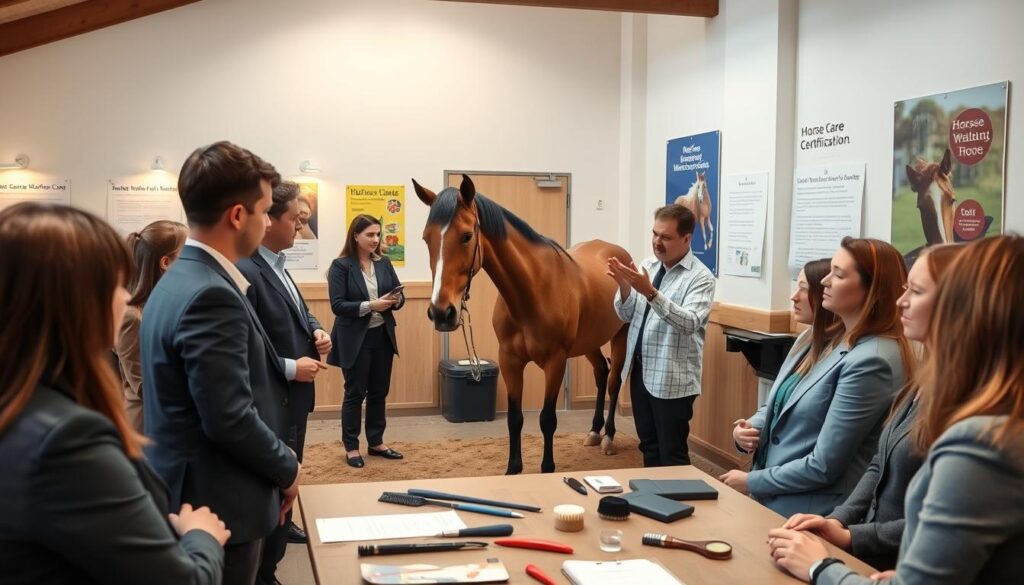
Look at established models for guidance. Equuvation’s “EquuSpecialist” program is a great example. It mixes online learning with hands-on workshops and mentorship. This mix of learn, do, and connect creates a complete learning system.
The industry has its gold standards. PATH Intl.’s CTRI and ESMHL credentials are top-notch. They show what a solid curriculum looks like. Your certification should aim for that level of respect.
So, what makes a strong program? Let’s explore:
| Component | Purpose | Example from Industry |
|---|---|---|
| Self-Paced Curriculum | Builds a strong foundation; fits different learning speeds. | Equuvation’s online modules on equine psychology and welfare ethics. |
| Experiential Workshops | Turns knowledge into real skills; shows ability. | Mandatory hands-on sessions for grooming, hoof care, and behavior reading. |
| Mentorship & Community | Ensures knowledge sharing and ongoing support. | PATH Intl.’s requirement for supervised teaching hours under a certified professional. |
| Formal Assessment | Validates skills objectively; keeps the program strong. | Written exams, practical skill demonstrations, and case study evaluations. |
The goal is to be accessible, not exclusive. Your goals must be tough yet clear for newcomers. It’s a balance between being serious and useful.
This effort turns your horse care workshops into a lasting legacy. You’re not just teaching horse care. You’re building a line of advocates who carry your values forward.
A good certification does more than prove skills. It builds a community with a shared language and standards. This is how you grow from occasional classes to a lasting institution in equine welfare.
Workshop Materials and Resource Packets
In today’s digital world, a physical resource packet stands out. It shows that some knowledge is worth keeping in a real, tangible form. This way, volunteers can easily refer to it, even when they’re offline.
This isn’t just about giving out binders. It’s about creating a living toolkit that helps volunteers long after the workshop. This toolkit makes your workshop’s impact last for months.
Equuvation’s “EquuFile” is a great example of this. It’s not just a bunch of PDFs. It’s a library with everything from program forms to sensory trail plans. It turns abstract ideas into immediately applicable tools.
Organizations like HETRA also know the importance of real tools. They give out handouts for weight limits and conditioning plans. This helps volunteers feel confident, not anxious.
The difference between a reference and a relic is key. A reference is useful and gets used often. It gets worn out, not just left on a shelf. For real skill building, your materials should be like field guides.
So, what should your packet include? Aim for a mix of:
- Foundation Documents: Core principles, safety protocols, and philosophical frameworks
- Practical Job Aids: Checklists, flowcharts, calculation sheets, and templates
- Visual References: Diagrams, photo guides, and identification charts
- Connection Tools: Resource lists, expert contacts, and community links
The physical aspect of your packet is important. It shows you value both the content and the person’s time. It’s saying, “This knowledge is worth keeping, not just deleting.”
Exceptional workshop materials empower, not just inform. They give volunteers the confidence to make decisions. The workshop may end, but the volunteer education continues. That’s when theory meets practice, and your investment pays off.
Feedback Collection and Continuous Improvement
If your workshop feedback system uses smiley faces and comment cards, it’s more like a popularity contest than advocacy training. The difference is clear. One shows temporary happiness. The other shows growth.
HETRA’s journey shows the importance of leadership and communication. They found these skills were essential. They listened to data that many ignore.
Forget the post-worksheet survey. It’s like a participation trophy. Real improvement needs a multi-layered intelligence apparatus. You need feedback before, during, and after learning.
Think like a detective, not an accountant. The goal is to find out why some skills stick while others don’t. Your advocacy training should be adaptable, just like it teaches.
Start with pre-assessment. Check what participants know and think before the workshop. Then, have structured debriefs with experts right after. Their insights are invaluable. They see which ideas spark real understanding.
The best data comes later. Follow up with participants weeks after. Ask what they used, not what they liked. Did they use new communication skills in tough conversations?
Consider silent observation. Watch how graduates interact with horses months later. Are they using the gentle handling methods? This feedback is honest and often different from what they say.
| Feedback Method | When to Collect | What It Measures | Actionable Insight |
|---|---|---|---|
| Structured Expert Debrief | Immediately post-session | Concept clarity & engagement peaks | Adjust pacing and case studies |
| Skill Application Survey | 4-6 weeks after workshop | Real-world implementation rate | Identify practical vs. theoretical gaps |
| Peer Observation Protocol | During practical sessions | Behavioral competence & safety | Refine hands-on coaching methods |
| Pre/Post Knowledge Assessment | Before first session & after final | Cognitive shift & retention | Validate curriculum effectiveness |
| Alumni Impact Tracking | Quarterly check-ins | Long-term advocacy outcomes | Demonstrate program ROI to funders |
This table isn’t a checklist. It’s a system. Each method helps improve in different ways. The expert debrief shapes your content. The skill survey changes your exercises. Observation updates your safety protocols.
Create a culture of humble inquiry. View feedback sessions as solving problems together. Ask: “How can we make this segment more useful for your actual work?” This turns participants into co-creators.
Document everything. Not in a dusty binder, but in a living document. Tag insights by workshop date, topic, and facilitator. Patterns will emerge. You might find that nutrition workshops need more visual aids. Or that policy sessions demand smaller groups.
The final test? Your willingness to kill a segment you love. If feedback shows an activity isn’t working, drop it. This intellectual humility is what makes education live.
Continuous improvement makes your advocacy training a lasting legacy. It ensures your program doesn’t just teach change. It becomes change itself.
Building Waiting Lists and Managing Demand and Scaling Workshops to Multiple Locations
Your workshop is a hit, and emails are pouring in. This is a great problem to have. It shows your program is valuable in volunteer education.
Scaling your workshop is a mix of philosophy and logistics. Can you capture the essence of your success? HETRA has a centralized event model that works well. Equuvation shows scalability by reaching different groups.
Don’t just copy a formula. Systematize what makes your workshop special. Turn your lead facilitator’s knowledge into a guide. This way, you build a team that can share your vision.
To grow, train your trainers and keep quality high. Choose locations wisely. You’re not just filling seats. You’re spreading your ideas far and wide. Success is when your methods inspire others.