

Welcome to the start of your journey to become a pilot. It’s not like what you see in Top Gun. This path is filled with lots of paperwork, not just cool flying tricks.
In 2001, I started my private pilot training at Oakland County International Airport. Josh, my instructor, was like my Yoda. He taught me that being a pilot is more about being precise than being a daredevil.
The journey has three main parts. First, you get a medical check that makes you think about your choices. Then, you dive into lots of studying. After that, you practice what you’ve learned, facing real challenges in the air.
Choosing the right flight school is a big decision. Your instructor is like a guardian, keeping you safe. Becoming a pilot is not just about flying. It’s also about passing through a tough test that shows you’re serious.
Medical, ground school, checklists
Think you’re ready to fly? The FAA has other plans. Your journey starts in a doctor’s office, checking if your body is ready for flying.
I learned this lesson the hard way when I called my Aviation Medical Examiner that morning. “Should I fast before my exam?” The receptionist’s cheerful “eat whatever you want!” became my downfall. That jelly-covered bagel turned my urine sample into a one-way ticket to Oklahoma City’s filing system.
Ground school is where Flight Simulator fans become real pilots. It’s like learning that watching Grey’s Anatomy doesn’t make you a brain surgeon. Now, Bernoulli’s principle is more important than your landing skills.
The classroom shows flying’s secret: it’s 80% knowledge, 20% skill. You’ll learn about wings, weather, and that little gyroscope that might save your life.
Then come the checklists. These aren’t just suggestions – they’re critical. Forget one item, and you’re not just having a bad day; you’re in for a NTSB report.
The irony is beautiful. We trust these papers to keep us safe thousands of feet up. Your medical clearance, ground knowledge, and checklist skills are key to avoiding aviation disasters.
Your AME visit is more than a medical exam – it’s about following instructions. Ground school is the foundation that keeps you on track. Checklists are the rhythm that turns chaos into order.
Master these three, and you’ve passed aviation’s first big test. Miss any, and Oklahoma City is waiting.
Managing Anxiety
Let’s talk about that moment when you realize you’re in a metal tube flying through the air. It’s not fear; it’s your brain’s survival instincts freaking out.
Feeling like you’re in a tin can in the sky? It’s a common feeling. Even pilots feel it, despite their tough exterior.
Anxiety is a sign of being self-aware. The goal isn’t to get rid of it. It’s about learning to live with it.
Smart pilots know how to handle this. They face their fear of flying but don’t let it control them.
Breathing, chair‑flying, simulator time
Let’s talk about the holy trinity of not losing your mind while learning to fly. These three techniques are what separate the white-knuckled student from the cool-headed pilot.
First up: breathing techniques. You might think breathing is automatic. But when you’re in a tight spot, your lungs might forget their job.
I learned to treat breathing like a yoga class for aviators. Inhale for four counts, hold for four, exhale for six. It’s amazing how oxygen can reboot a panicking brain. My instructor calls it “not hyperventilating into the radio.”
Next comes chair-flying – the aviation version of air guitar. You sit in your favorite chair, close your eyes, and run through emergency procedures while making engine noises.
Your family might think you’ve snapped. But you’re actually building muscle memory for when things go wrong. I’ve practiced engine-out scenarios so many times, my dog now recognizes the “mayday” tone in my voice.
The beauty of chair-flying? It’s free. It’s available 24/7. And you can’t crash your La-Z-Boy (though I’ve come close during enthusiastic practice sessions).
Then there’s simulator time – the video game that might save your actual life. Modern flight simulators are so realistic they’ll make you sweat without leaving the ground.
I’ve crashed more times in the sim than I care to admit. But here’s the magic: each virtual disaster teaches something real. You learn recovery techniques without the pesky downside of actual death.
The best part? When you get it right in the sim, that confidence transfers to the real cockpit. It’s like having cheat codes for flying.
These three techniques transformed my anxiety management approach. They turned panic into preparation. The fear doesn’t disappear completely – but it becomes something you can work with.
I’ve even started being open about these practices with my instructor and family. Turns out, admitting “I sat in my chair making emergency landing noises for an hour” gets more understanding nods than you’d expect.
The Solo Day
That drive to the airport feels like the longest walk to the principal’s office of your life. But you’re the principal, the student, and the disciplinary committee all in one.
Your passenger seat has that invisible luggage—the “anxiety bag” that moves with every turn. It’s packed with worries like mortgage payments, loved ones’ worried faces, and endless “what ifs.”
This isn’t about not feeling fear. It’s about feeling capable despite fear. You learn that courage isn’t the absence of fear but choosing what matters more.
Many aviation veterans say this moment is their defining change. The training wheels come off, and you’re not just practicing—you’re flying.
Weather brief, pattern, landing
Weather forecasting for pilots is more about making smart guesses than predicting the future. Meteorology is like making educated guesses while hoping the weather doesn’t change. The weather brief is a daily ritual that shows pilots don’t control the weather, but they can work with it.
Pattern work is like riding a bike in circles until it becomes second nature. It’s a dance of downwind, base, and final turns that turns coordinated flight into muscle memory. This process builds neural pathways that could save your life someday.
The landing phase is like an art form of controlled crashing. You learn that the ground is harder than it looks from up high. It’s not just about landing; it’s about knowing when to go around, which is just as important.
Consider a pilot who did 11 trips around the pattern before soloing. These weren’t extra laps; they were an instructor’s way of ensuring the student’s safety. The student practiced different flap settings, short approaches, and simulated engine failures. This method turns panic into procedure.
Pattern work teaches you that perfection isn’t the goal. Consistency is. Learning to recognize when something’s not right is the real victory. The pattern is your classroom, the landing your exam, and the go-around your smartest answer when things go wrong.
This trilogy—weather interpretation, pattern precision, and landing judgment—is the foundation of flight training. Master these, and you’re not just learning to fly. You’re learning to think like a pilot.
After‑Action Review
That moment when your brain catches up with your body—welcome to the after-action review. It’s a mix of analysis and emotional processing. Imagine a NASA debrief and a therapy session combined.

Remember that pilot who felt numb while taxiing back? They were in autopilot mode. This shows how important safety is. Your body acts while your mind deals with the emotional side of being self-reliant.
This isn’t just about fixing mistakes. It’s about making your experiences part of who you are. The hard part isn’t flying the plane. It’s figuring out what it means to be fully responsible for it.
This reflective practice turns near-misses into chances to learn. As explained in this aviation analysis, proper debriefing makes experience valuable.
Your after-action review is more than just paperwork. It’s where you say “holy shit, I actually did that” and grow from it.
Lessons learned, logbook entry
The cockpit falls silent after engine shutdown. But your mind is buzzing. That moment after your first solo flight is like the final scene of a coming-of-age movie. You’re both the hero and the audience.
Your instructor’s signature in your logbook is huge. It’s like getting a knighthood: “First solo – 3 landings – C152.” Just three landings and six words change everything.
Reflection after the flight is where the magic happens. You learn that confidence grows in quiet moments, not in the air. The plane followed your commands because you’d worked hard to earn its trust.
Important lessons come out like photos from a film:
- Procedures are more important than being perfect
- Believing in yourself grows faster than skills
- The real learning happens between simulation and reality
The logbook entry is your proof of new skills. It’s simple and doesn’t show the emotions. But in aviation, it’s the only proof that counts.
The fuel truck arrives as your instructor signs off. It’s a sign of fuel for your plane and your confidence. You get both literally and metaphorically.
Your logbook shows you flew alone and made it. It proves you found new abilities. The signature is just the start; the real deal is between you and your hidden talents.
Gear & Tech
Let’s talk about the gear that separates pilots from passengers. Nothing says “I’m serious about aviation” like spending more on equipment than your first car’s down payment.
The 1950 PA-20 is more than an aircraft. It’s a time machine with wings. Sometimes, the old ways are the best in aviation.
Choosing between modern tech and vintage romance is like picking between a typewriter and a MacBook. Both get the job done, but one has more character—and possibly more surprises.
Your tools should help you fly, not decide how you fly. Fancy equipment can’t make up for bad decisions. But the right gear can make good decisions even better.
Headsets, EFB apps, kneeboard
Forget what you saw in Top Gun – real pilots use a special set of gear. It combines old-school charm with modern tech. It’s not about looking cool; it’s about staying alert with lots of data.
Headsets are key. They protect your ears from loud engines. They also connect you to air traffic control and help when it’s noisy.
EFB apps are the digital change that made paper charts outdated. Your iPad turns into a control center. It’s like having a mini-mission control.
These apps give you real-time weather and maps. They update fast, making flying feel both advanced and a bit odd. We’re flying old planes but with new tech.
The kneeboard is like a cheat sheet. It holds emergency procedures. Trying to remember them in an emergency is hard.
We fly the same planes as before but with new tech. This gear mixes old charm with new tech. It keeps flying exciting and safe.
Your aviation gear shows how you fly. Do you prefer old ways or new tech? Or do you mix both?
Budget & Time Hacks
Welcome to the world of private pilot training. Life has a funny way of interrupting your plans. Just ask a lawyer trying to balance family and flying lessons.
Managing your budget for flying isn’t about finding coins under the couch. It’s about handling a lot of expenses without getting overwhelmed. Think about instructor fees, aircraft rentals, and fuel costs—it’s like a never-ending bill.
Time management is key. You’ll learn to fit lessons into your busy schedule. The trick? Sometimes, it’s better to wait until you’re well-rested to fly.
Smart students fly when it’s less busy, look for scholarships, and manage their budget carefully. Rushing through private pilot training might get you there fast, but you’ll miss important details.
Scheduling, scholarships
Flight training scheduling is like playing Tetris with moving pieces and weather. It’s not just about planning your time. You must also deal with aircraft availability, instructor schedules, and weather changes.
Here’s a secret: treat your training like a professional development. Book time weeks ahead, just like any important project. And have a plan B for when the weather cancels your flight.
Now, let’s talk about scholarships. They’re like finding treasure in the aviation world. But, those who need it most often can’t afford it. And applying for scholarships takes a lot of effort.
Scholarship committees don’t want your sad story. They look for commitment, clear goals, and progress. Your application should be a strong case for why they should invest in your aviation future.
Here’s a smart plan: make a spreadsheet for tracking scholarships. It should have deadlines, requirements, and follow-up dates. Set aside time each week for applications. It’s not a hobby, it’s an investment in your skills.
Every professional pilot has gone through this. The paperwork headache will go away, but your certification will last forever.
Community Role
Where else do people talk about engine failure over breakfast? Only in the aviation community, where coffee tastes like jet fuel. The conversations could save your life.
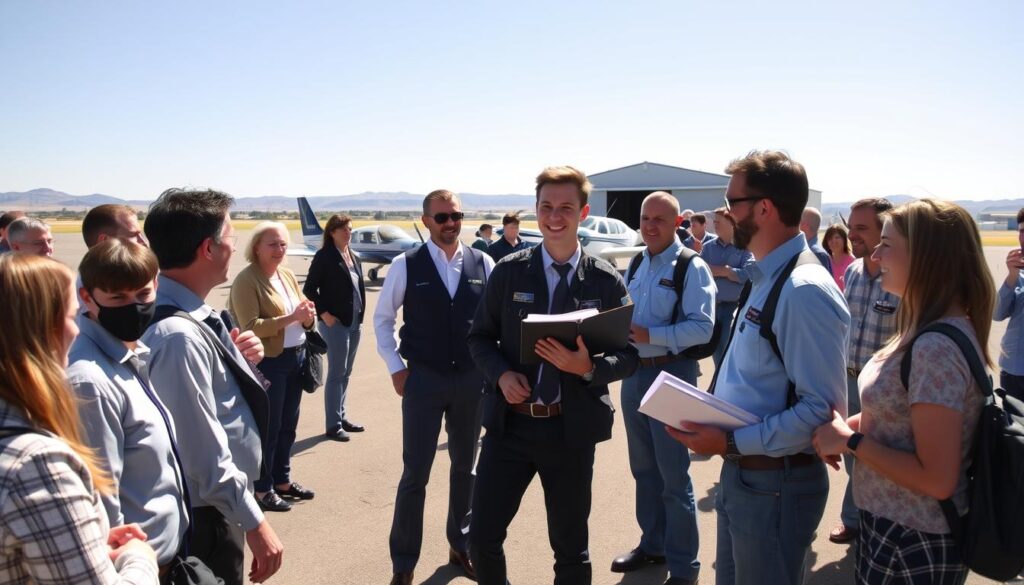
One pilot said it best: “The aircraft are incredible, and the people are even more so.” It’s not just about flying machines. It’s about the people who love them.
Imagine having hundreds of copilots who’ve flown through the weather you’re facing. You get to learn from their war stories, near-misses, and mistakes you haven’t made yet.
This shared wisdom is a mutual survival pact. In a solo activity, we find our need for shared knowledge. The community acts as your external memory bank for experiences you haven’t had.
It’s not just about being friends—it’s about having intellectual insurance. Where else can you find people ready to help another aviator? Only in this amazing tribe of sky-lovers.
Club mentors, safety seminars
Ever wish you had a cheat code for aviation? Welcome to the world of club mentors—the living, breathing Wikipedia of flight wisdom. These aren’t your typical instructors. They’re pilots who’ve turned near-disasters into stories to tell at parties, with more experience than most logbooks.
Their value isn’t measured in flight hours but in mistakes survived. They’re like that friend who’s already dated all the wrong people so you don’t have to. Why repeat errors when you can learn from someone else’s spectacular miscalculations?
Then there are safety seminars—where pilots gather to discuss how not to die. These sessions are often accompanied by coffee and donuts. It’s believed that discussing mortal danger goes better with caffeine and sugar. These sessions turn dry regulations into life-saving wisdom.
Consider this: pilots represent just 0.5% of the US population. We’re a tiny tribe in a world of earth-bound mortals. This creates instant camaraderie—a shared understanding that transcends ordinary small talk. When a mentor shares a “war story,” they’re not bragging. They’re handing you survival tools.
Here’s what these resources provide that manuals can’t:
- Context behind regulations
- Real-world application of procedures
- Unwritten rules of aviation culture
- Network of support for unexpected situations
The best part? This wisdom transfer happens organically. It’s like Yoda meets your favorite bartender—profound advice delivered with casual authenticity. You’ll find these mentors leaning against hangar doors, sipping coffee while casually dropping knowledge bombs that could save your life.
| Resource Type | What You Gain | When to Use It |
|---|---|---|
| Club Mentors | Personalized experience sharing | Before new flight phases |
| Safety Seminars | Collective risk analysis | Quarterly refreshers |
| Hangar Discussions | Informal tips and tricks | Ongoing learning |
These interactions transform textbook knowledge into instinct. You stop following rules and start understanding why they exist. That’s the magic of learning from those who’ve already navigated the turbulence—both literal and metaphorical.
The aviation community thrives on this shared wisdom. It’s how we maintain safety standards while continuing to push boundaries. So next time you see that seasoned pilot nursing a coffee in the corner—pull up a chair. The stories might save more than just your afternoon.
Advice for New Pilots
Let’s face it: the pre-flight jitters are tougher than any turbulence. Your stomach dances the Macarena, and your mind runs through all the bad scenarios. But here’s the twist—once you’re up in the air, things often calm down.
Your flying journey isn’t a race. It’s not fair to compare your early fears to someone else’s calm. That calm pilot next to you? They were once just as nervous on their first solo.
The key change isn’t getting rid of doubts. It’s about gaining trust. Trust in your training, your plane, and yourself. Every pro started as a newbie, unsure of what to do. The difference? They’ve logged hours and learned from their mistakes.
Step‑by‑step starter plan
Welcome to aviation’s version of assembling IKEA furniture—the instructions seem straightforward until you’re holding three extra screws and questioning your life choices. Your flight training journey begins with what appears to be a linear path but quickly reveals itself as more of a choose-your-own-adventure novel with occasional weather-related plot twists.
Step 1: The Medical Certificate – Where you prove to the FAA that you’re medically qualified to potentially become an aviation statistic. Think of it as a reality check before the reality checks.
Step 2: Ground School – This is where you learn enough theory to be dangerously confident about things you’ve never actually done. It’s the classroom portion that makes you wonder why airplanes need so many buttons.
Step 3: Discovery Flight – The aviation equivalent of a first date with gravity. You’ll either fall in love immediately or realize this relationship requires more commitment than you’re ready for.
Step 4: Regular Lessons – Where repetition turns confusion into competence through sheer force of practice. This phase typically involves developing a love-hate relationship with your instructor.
Step 5: Solo Flight – The moment you discover your instructor was never the safety net you imagined—just someone who knew when to stop touching the controls.
Step 6: Cross-Country – Because flying in circles gets philosophically unsatisfying after a while. This is where you learn that getting somewhere requires more than just pointing the airplane in that direction.
Step 7: Checkride – The aviation final exam where you prove to a stranger that you won’t kill yourself or others while operating expensive machinery.
The beautiful part? This step-by-step starter plan isn’t actually linear—it’s more like two steps forward, one step back, with occasional sideways moves when the weather doesn’t cooperate. Your flight training journey will feel less like climbing a ladder and more like ascending a spiral staircase toward competence.
Each phase builds on the previous one while occasionally making you revisit skills you thought you’d mastered. The pattern work that seemed so straightforward during your solo flight suddenly feels different during cross-country preparation. The radio communications that once terrified you become second nature—until you call a busy Class B airport.
Remember that this aviation journey resembles evolution more than revolution. Progress happens in small increments between moments of frustration and breakthroughs. The pilot certificate waiting at the end represents not just skill acquisition, but the transformation of how you think about risk, preparation, and your relationship with technology.
Your flight training adventure will teach you that the destination matters less than who you become along the way. Unless you get lost during cross-country—then the destination matters quite a lot actually.
Photo Highlights
Let’s talk about the elephant in the room in aviation: if you didn’t take a photo, did you really achieve it? We’re looking at those perfect moments that make flying look like a dance.
The cockpit shot is special, known only to pilots. It shows off your knowledge of flying. Then, there’s the photo where you try to look like a pro pilot, not someone who just faced their biggest fear.
And then there’s the quirky hazing ritual in aviation. The shirt tail ceremony is like getting your wings, but with more cutting and a bit of torn fabric.
These photos are more than just for show. They prove you’ve changed and overcome something big. They’re like proof for your future self and a great way to make your friends on the ground jealous.
Airfield moments
The syllabus covers procedures and maneuvers, but the curriculum of camaraderie writes itself on the tarmac. These unscripted interactions become the doctoral thesis of your aviation education.
Take that morning Josh introduced me to the Stearman pilot. “He’s coming along fine,” Josh said, “except that he needs at least a seven-knot crosswind to land.” The comment landed better than my actual landings. That gentle ribbing—aviation’s version of hazing—meant I’d been accepted into the tribe.
Airfields operate on their own sensory economy. The smell of avgas mingling with fresh coffee creates a peculiar morning perfume. Sunlight hits runways at golden hour like nature’s own approach lighting system.
Radial engines cough to life with the reliability of a grumpy uncle waking up. These details form the backdrop against which your aviation journey unfolds. They’re not incidental—they’re essential context.
The airfield functions as aviation’s living room. Here, hangar flying stories get embellished with each telling. Coffee is consumed while preflighting, and help is offered without being asked.
This ecosystem transforms mechanical operations into human connections. The airfield isn’t just a place—it’s a character in your story. And like any good character, it reveals itself gradually through meaningful moments.
Your Turn at the Controls
So here’s where the rubber meets the runway. Your aviation journey isn’t a solo flight—it’s a formation where every story matters. That first white-knuckle takeoff? The triumphant solo landing? They’re not just personal victories but contributions to our collective flight manual.
Think of the aviation community as the world’s most interesting cocktail party—minus the bad hors d’oeuvres. We’ve got seasoned captains who get butterflies and new students teaching old dogs new tricks. There’s no hierarchy here, just different altitudes of experience.
Your story adds color to our skies. What made you trade solid ground for thin air? Was it the romance of flight or just really disliking traffic? Share your first solo experience, your pre-flight jitters, that perfect crosswind landing.
The runway’s open. The frequency is clear. Your voice belongs in this conversation because every pilot—from first lesson to thousandth flight—holds a piece of aviation wisdom. Let’s hear yours.