
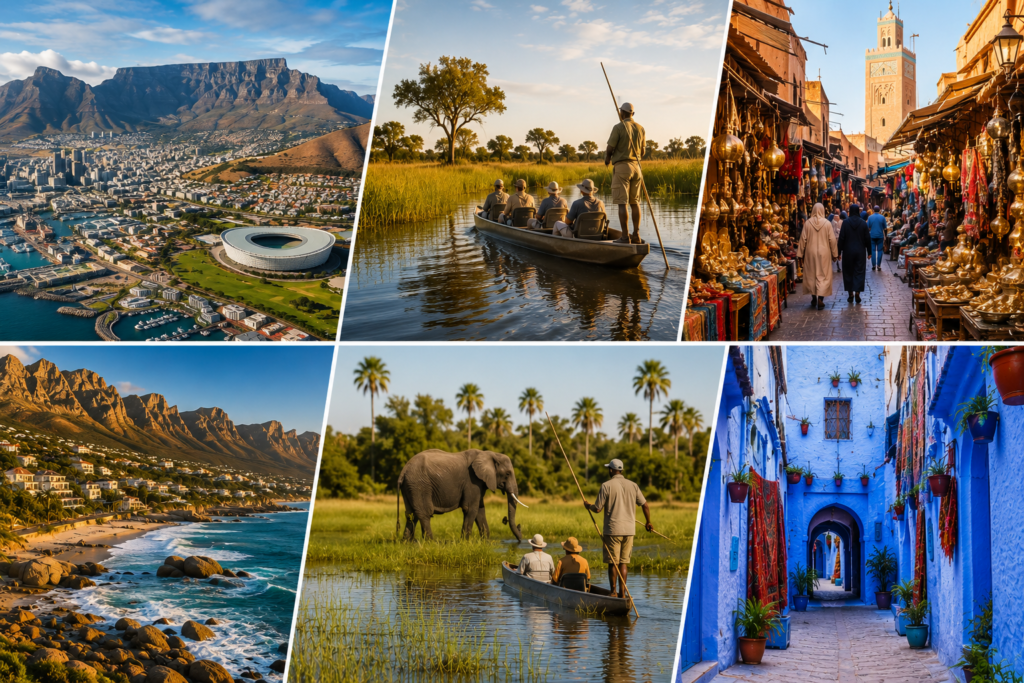
Top African Travel Destinations: Exploring Cape Town, Okavango Delta & Marrakech’s Medina
Continental Africa presents vast ecological and cultural diversity. Evaluating top African travel destinations requires analyzing specific geographic regions. Cape Town offers coastal infrastructure and distinct geological formations. The Okavango Delta provides untouched wildlife habitats within an inland river system. Marrakech features preserved historical trade routes and ancient architecture. Selecting the right location depends entirely on balancing wildlife viewing priorities with architectural curiosity. Each location demands distinct preparation, timing, and logistical awareness. Reviewing our international travel guides helps travelers establish exact packing lists for these distinct climates.
Cape Town Geography And Coastal Climate
Cape Town anchors the southwestern tip of South Africa. The city operates around the massive geological formation of Table Mountain, which actively dictates local weather patterns through sudden cloud cover known locally as the “tablecloth.”Two major ocean currents, the cold Benguela and the warm Agulhas, intersect near the Cape Peninsula. This marine convergence creates microclimates directly affecting local agriculture and biodiversity. The resulting environment supports distinct flora, known as fynbos, entirely endemic to the region.

Visitors observe penguin colonies at Boulders Beach and hike the steep trails of theCape of Good Hope. Just outside the immediate urban center, the specific soil compositions of Stellenbosch and Franschhoek support a world-renowned viticulture industry. The Mediterranean climate brings dry summers and wet winters. Planning a visit between November and February guarantees the most stable weather for outdoor activities and coastal exploration. The local infrastructure supports seamless movement between historical sites like Robben Island, urban centers, and surrounding natural reserves.
Ecological Dynamics In The Okavango Delta
Botswana contains the Okavango Delta, an immense inland river system created by complex geological fault lines. Seasonal flooding from the Angolan highlands dictates the movement of regional wildlife. Water reaches the delta between March and June, transforming arid plains intoflooded grasslands. This hydrological cycle supports high concentrations of elephants, hippopotamuses, and large predators. The area serves as a critical refuge for endangered species, including the African wild dog. The strict environmental protection laws in Botswana limit tourist numbers, directlypreserving the integrity of the ecosystem.
Safaris utilize traditional mokoro canoes to traverse the shallow channels without disturbing the animals. Proper African safari planning secures permits and accommodations well in advance of the dry season. The sheer scale of the wetland requires experienced local guides to track migratory herds. Reaching remote camps often involves specialized light aircraft flights, keeping the human footprint minimal. Predators follow the grazing animals inward as the water levels rise, creating highly concentrated wildlife viewing opportunities along the central islands.

Historical Architecture Within The Marrakech Medina
The Marrakech Medina represents centuries of North African trade history. Surrounded by imposing red sandstone walls, the ancient city functions through a dense grid of narrow alleys and courtyards. The central square, Jemaa el-Fnaa, serves as a permanent focal point for commerce, food stalls, and cultural exchange. Islamic architectural elements dominate the structures, featuring intricate tilework, known as zellij, and carved cedar wood ceilings visible in preserved sites like the Bahia Palace.
Moving through the Medina requires spatial awareness and an appreciation for local commerce. Visitors negotiate prices for spices, textiles, and ceramics directly with artisans in their workshops. Staying in a traditional riad offers direct insight into local domestic life. These historical guesthouses feature interior courtyard gardens that provide immediate refuge from the intense desert heat outside the walls. Just beyond the Medina walls, the French-influenced Gueliz district presents a stark structural contrast, showcasing early 20th-century urban planning alongside traditional Moroccan elements.
Geological Scale At Victoria Falls
Bordering Zambia and Zimbabwe, Victoria Falls represents a massive tectonic fracture in the Earth’s crust. The Zambezi River plunges directly into a deep basalt gorge, creating a localized rainforest microclimate supported by continuous water spray. The sheer volume of water creates a visible vapor column reaching hundreds of meters into the air.
Helicopter surveys provide a clear assessment of the geological fault lines extending through the surrounding plateau. Ground-level infrastructure includes paved trails leading to various observation points along the gorge edge. Water levels dictate the intensity of the falls, peaking between February and May following the regional wet season. Lower water periods allow access to natural rock pools situated near the edge of the drop.

Terrestrial Migration In The Serengeti
The Serengeti National Park in Tanzania supports the largest terrestrial mammal migration globally. Millions of wildebeest and zebras move across the plains in a continuous search for water and fresh grazing land. The timing of this movement correlates directly with regional rainfall patterns and localized vegetation growth.
Conservation efforts in East Africa rely heavily on structured tourism revenue. Managed park fees fund anti-poaching units and local community initiatives. Visitors interact with the environment through regulated safari vehicles driven by certified regional experts. Ground operators enforce strict approach distances to minimize stress on the migrating herds and resident predator populations.
Antiquities Preservation Along The Nile
The Nile River dictates the historical and modern settlement patterns of Egypt. The Giza Plateau sits on the edge of the western desert, housing the Great Pyramids and the Sphinx. These limestone and granite structures demonstrate advanced ancient engineering and precise astronomical alignment. Dry desert conditions have facilitated the preservation of these monuments over millennia.
Modern infrastructure connects Cairo directly to southern archaeological sites in Luxor and Aswan. River cruisers provide a logistical solution for observing the continuous string of temples along the riverbanks. High summer temperatures make archaeological site visits physically demanding. Scheduling trips between November and March guarantees cooler weather for extended outdoor exploration.
Regional Comparison Overview
| Destination | Geographic Region | Climate Type | Primary Feature | Optimal Travel Season |
|---|---|---|---|---|
| Cape Town | South Africa | Mediterranean | Coastal Mountains | November – February |
| Okavango Delta | Botswana | Semi-Arid Wetland | Inland River Delta | June – August |
| Marrakech Medina | Morocco | Semi-Arid | Historic Architecture | March – May |
| Victoria Falls | Zambia / Zimbabwe | Subtropical | Geological Formations | February – May |
| Serengeti Plains | Tanzania | Tropical Savanna | Terrestrial Migration | June – October |
| Giza & The Nile | Egypt | Arid Desert | Ancient Monuments | November – March |