
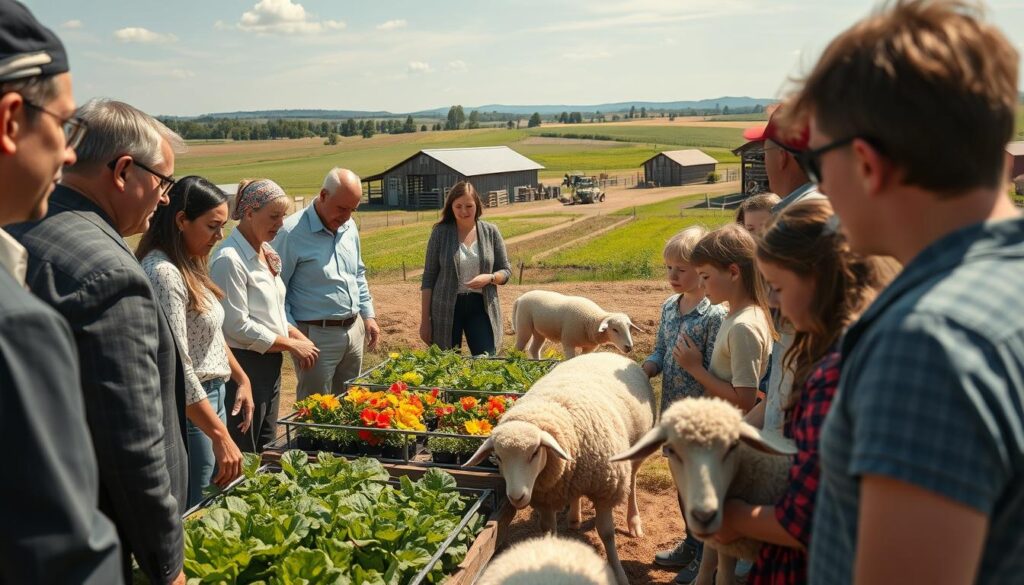
Forget what you think you know about field trips. Today’s educational visit is more than just watching. It’s like going on an intellectual safari.
Imagine a TED Talk by a tomato plant. You walk through the presentation. Many trips promise real experiences but feel like a petting zoo. The real magic is in the journey’s design.
We don’t just show rows of veggies. We take you on a journey of ecological care. It’s about turning curiosity into understanding, using the land as our guide.
Visitors say these tours are “pure magic.” They last from 45 minutes to an hour. They offer real insights into sustainable practices from those who live them every day.
So, what makes a trip memorable? It’s like the difference between watching a movie and meeting the director. They show you the real story behind the scenes.
Staff Training for Public Interactions
Think of your staff as diplomats, not just tour guides. They work in the barnyard, handling goats, soil, and even helping kids with muddy boots. This is where they meet the public, making a big difference.
Training usually focuses on facts like dates and breeds. But visitors don’t follow scripts. Kim Read at Auerfarm knows this. She creates projects that spark deeper conversations.
Visitors can get bored, making experts seem like robots. But when staff can adapt, magic happens. They explain complex topics in simple ways, showing real community engagement.
Staff should be like Sages, sharing knowledge casually. They see questions as chances to share more. One farm director wants to give everyone meaningful experiences, starting with a safe and welcoming team.
So, what does this training look like? It’s more like an improv workshop than a lecture hall.
- Scenario Drills: Role-playing to connect with all kinds of visitors. It’s about finding common ground.
- Empathy Mapping: Understanding what different visitors need. It’s not just about giving information.
- The “Why” Behind the “What”: Staff should know the reasons behind the farm’s practices. This makes the facts more interesting.
When educators focus on deeper interactions, visits become more meaningful. The farm becomes a living classroom. Conversations started on the tour can continue at home or in school, as Kim Read hopes.
Your staff are your most valuable asset. Under-trained, they’re a risk. But with the right training, they spark curiosity and create lasting connections. They make sure visitors learn and remember, building a community one conversation at a time.
Safety Protocols for Visitor Groups
Keeping visitors safe at a rescue facility is more about trust than fences. It’s about making sure everyone knows the risks. This way, they can enjoy their visit without worry.
For rescue facility tours, safety is key. These tours are different from petting zoos because the animals have their own stories. They might be healing, have special needs, or just be a bit wild.
Facilities adjust their tours for all kinds of groups. This means different rules for kids and adults. Kids need clear rules, while adults need to understand the ethics of seeing these animals.
Erica Fearn, Executive Director, said, “…we worked tirelessly to ensure the access to education and safety for all of our students, visitors, and staff were foremost.” Safety comes first, but it’s all about learning too.
So, what does this mean in real life? It’s like a checklist for safety, making sure everyone has a good time.
First, we learn about the group coming. We check for allergies, mobility issues, or fears. This helps plan the tour.
Then, we have a talk about the rules. It’s not just about following rules. It’s about understanding why we do things a certain way.
Lastly, the staff is key. They watch both the animals and the visitors. They know when it’s time to be careful.
| Safety Aspect | Standard Farm Tour | Rescue Facility Tour |
|---|---|---|
| Primary Risk Focus | Trips, falls, basic animal interaction | Animal triggers, visitor behavior, medical contingencies |
| Interaction Rules | Often “look and touch” with supervision | Strictly “look and learn” with defined no-go zones |
| Emergency Preparedness | First aid kit, call 911 | Tiered response: guide action, staff backup, vet on call |
| Staff Training Emphasis | Animal knowledge, crowd control | De-escalation, risk assessment, specific animal histories |
| Adaptability During Tour | Minor route adjustments for weather | Dynamic rerouting based on animal mood or visitor group needs |
The table shows the big difference. A standard tour deals with basic risks. But a rescue facility tour handles the unique stories of each animal.
This careful planning doesn’t limit the experience. It actually makes it better. When visitors see the safety measures, they feel more at ease. This trust lets them truly enjoy their visit.
In the end, safety protocols are the best way to show you care. They prove you’re professional and ethical. They turn a simple visit into a meaningful learning experience. And they make sure every story of rescue is heard with respect.
Educational Signage and Information Stations
A wall of text is like homework for your eyes. A well-made information station invites you to learn and explore. It’s like a silent guide that shares your farm’s story between tours.
Done right, it’s not just clutter. It’s a path to understanding that leads to “aha!” moments. Your transparency initiatives come alive here.
Don’t just label a field “Cover Crop.” Tell me it’s crimson clover and how it helps the soil. Add a joke to make it fun. This turns a simple label into a story of care for the land.
Thematic stations are your secret weapon. They’re like chapters in your farm’s book. For example, an Animal Theme station might talk about heritage breeds and how they’re raised.
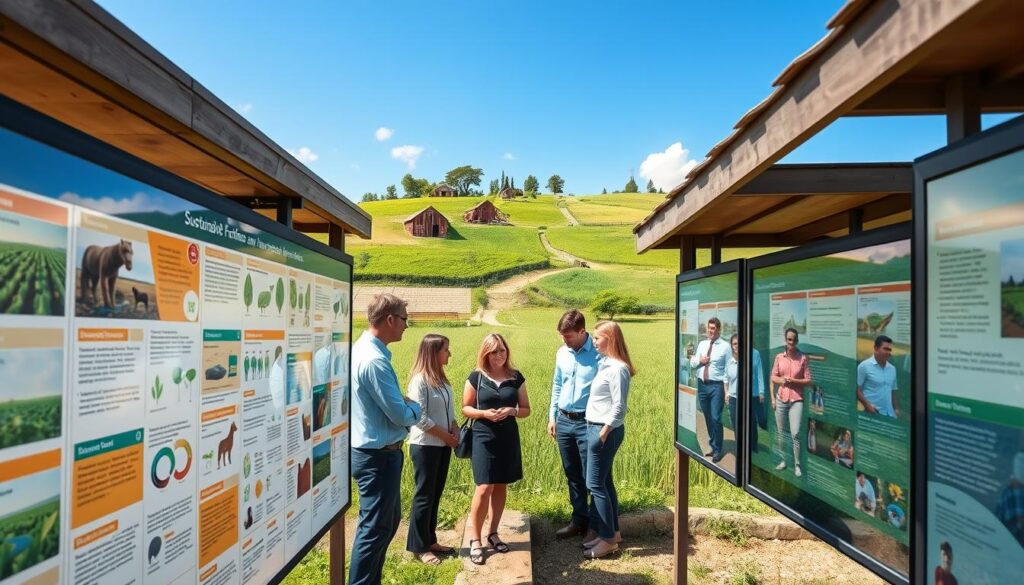
Here’s how common thematic anchors can translate into engaging station content:
| Program Theme | Station Focus Example | Interactive Element Idea |
|---|---|---|
| ANIMAL THEME | Lifecycle of a laying hen; pasture rotation benefits. | QR code linking to a farmer interview video. |
| PLANTS THEME | “Apples and Apple Trees” from blossom to harvest. | Touch-and-smell box with different apple varieties. |
| FORESTRY THEME | Soil health and mycelium networks. | Analogy comparing fungal networks to the internet. |
| EARTH SCIENCE THEME | “Bees and Pollinators” and their role in the ecosystem. | Magnifying glass station over a (safe) observation hive diagram. |
The magic is in the layers. A quick fact for the casual visitor and more for the curious. This layered approach is the heart of transparency initiatives. It shows, “We have nothing to hide, and so much to share.”
Clever wordplay and smart analogies help. Comparing compost to a slow-cooker meal makes it easy to understand. It’s not simplifying science; it’s making it accessible.
Great educational signage lets visitors take control. It turns a walk into an adventure in sustainability. For facilities wanting to improve, working with a specialist like Exhibit Farm can make a big difference. The goal is to spark a passion that lasts a lifetime.
Special Needs Accommodation Planning
If your farm tour feels like a one-size-fits-all experience, you’ve already failed. We’re not running a factory assembly line here. True intellectual hospitality means designing educational visits that welcome every brain and body through the gate.
Think of it this way: ADA compliance is the bare minimum, like showing up to a dinner party with only a bag of chips. Real accommodation planning is the seven-course meal. It’s the thoughtful design that asks, “How can we make this revelation about soil microbiology accessible to someone who processes information differently?”
Let’s deconstruct the barriers with the same rigor we apply to analyzing crop rotation. Physical access is just the opening act.
- Sensory-Friendly Navigation: Standard maps are visual chaos. We create simplified, high-contrast versions with clear pathways. For visually impaired visitors, audio descriptions turn the compost pile into a symphony of decomposition.
- Cognitive Flexibility: Programming shouldn’t be a rigid script. We build in natural pause points. Concepts can be explored through multiple lenses—tactile, auditory, or narrative—without diluting the science.
- Pacing as Pedagogy: Some groups need to move slowly, observing one chicken for twenty minutes. Others thrive on rapid-fire Q&A. Both approaches can arrive at the same understanding of animal husbandry.
The socioeconomic barrier is often the most invisible fence. One source mentions sliding scale pricing and financial aid. This isn’t charity—it’s intellectual justice. If cost prevents a classroom from visiting, you haven’t planned an educational visit. You’ve planned an exclusive field trip for the privileged.
Now, consider the virtual turn-key solution. The other source describes these as minimal-supply experiences designed for platforms like Google Classroom. This isn’t a lesser alternative. It’s a brilliant parallel pathway. A student with mobility challenges or social anxiety can engage with the same core curriculum from their kitchen table.
Let’s get analytical. Here’s what separates compliance theater from genuine inclusion:
| Traditional Approach | Inclusive Design Philosophy | Outcome for Visitor |
|---|---|---|
| Installs a ramp because code requires it | Designs the entire pathway network to be navigable by all | Independent exploration without assistance |
| Offers a standard scripted tour | Trains staff in multiple communication styles and pacing | Personalized learning that matches their processing speed |
| Charges a flat fee per student | Implements a transparent sliding scale with no-stigma aid | Economic background doesn’t gatekeep education |
| Considers virtual tours as “second best” | Engineers digital experiences as primary, equally valid options | Choice of engagement modality based on need, not hierarchy |
The goal isn’t to create a separate, sanitized experience for “special” groups. That’s the old model, and it’s as outdated as using a scythe to harvest 40 acres. The new paradigm engineers multiple pathways to the same core revelation.
Every visitor should leave understanding that a farm is a microcosm of our working world. Whether they absorbed that through their fingertips in the wool of a sheep, through headphones describing the barn’s architecture, or through a virtual simulation of crop growth—the intellectual destination is identical.
Planning for special needs transforms your educational visit from a passive tour into an active dialogue. It signals that every perspective is valued. That every mind deserves access to the wonder of how things actually work. Isn’t that the whole point?
Photography and Privacy Considerations
The modern farm tour is a mix of wanting free marketing and not wanting to be a digital zoo. Every visitor has a high-definition camera, making your farm a privacy risk. This can make your workday stressful and your visitors uncomfortable.
Your staff should have a day without being watched like paparazzi. Visitors, including families with kids, expect privacy. Even your animals might not want to be photographed. Instead of saying no photos, create a social contract that turns photos into community engagement.
Designate “photo op” zones with good lighting and friendly animals. A friendly goat at the entrance and a pretty compost pile with a sign are great. You’re not stopping creativity but guiding it to tell your story.
Also, mark no-photo zones like private areas and sensitive animal habitats. Use fun signs like “Shhh… Our chickens are meditating” to keep boundaries while being witty.
Train your staff to handle photographers politely. A simple “The sheep are shy today, but our pony, Buttercup, loves the camera!” can help. This doesn’t stop sharing but makes it better for everyone.
Here are key points for your photography policy:
- Animal Welfare First: No flash near animals and no treats for photos.
- People-Focused Privacy: Always ask before taking photos of others, like children.
- Commercial Use Clarity: Say professional photos need permission and might cost.
- Social Media Tagging: Use a unique hashtag for your farm to track photos.
This approach does more than avoid problems. It shapes your farm’s online image. When visitors share photos, they’re supporting your values and joining your story.
Managing photos is about telling your story. You invite people to share the good and the real. A good photo policy builds trust. It shows you care about your community’s experience. This turns a simple photo into lasting community engagement.
Group Size Management Strategies
Managing group size is more about creating connections than just counting heads. Get it right, and you help people connect on a personal level. Get it wrong, and it feels like herding a confused crowd. Just a few extra people can make all the difference.
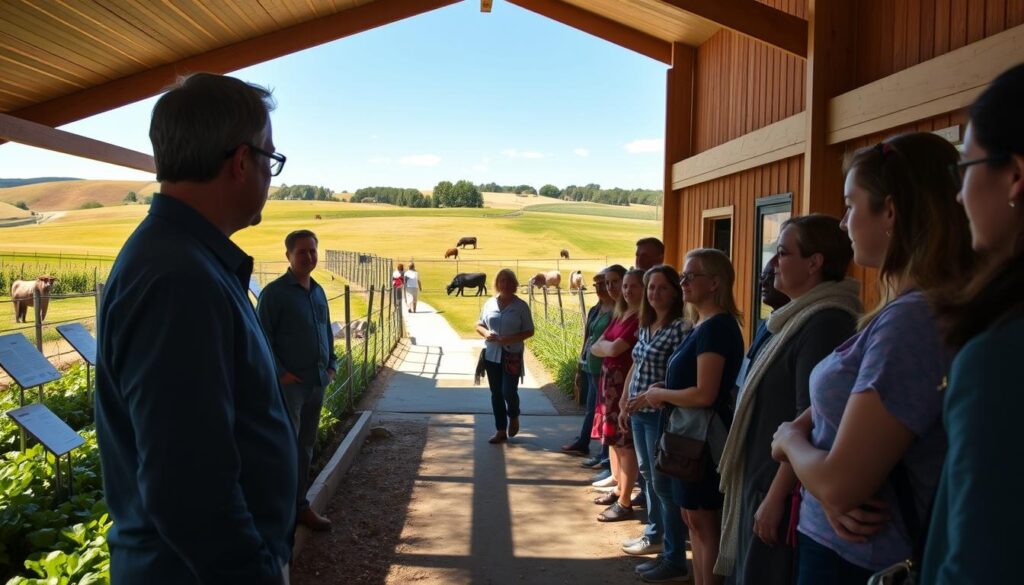
Imagine a 45-minute to one-hour farm tour. A group of 15 to 20 guests is perfect. It’s lively but small enough for everyone to see the baby goats and hear the guide’s stories.
Now, think about a rescue facility tour. Here, the rules are different. You’re working with tight spaces and animals with sensitive pasts. The goal is to educate with compassion, not just entertain. A group of 10 is the max here. It’s about safety, animal welfare, and meaningful conversations.
The virtual world offers a different approach. A “Classroom Package up to 30 users” works well here. The screen allows for a lecture format, focusing on information sharing. The goal is to match your capacity to your educational aim.
Are you looking for hands-on learning or a lecture-style experience? Your pricing, staffing, and guest experience should reflect this choice.
Let’s look at the strategy visually. The table below is more than numbers; it’s a guide for the experience you offer.
| Tour Type / Focus | Ideal Group Size | Primary Rationale | Experience Vibe |
|---|---|---|---|
| Standard Educational Farm Tour | 15 – 20 guests | Balances engagement with manageability for a 45-60 min tour. Allows for clear viewing and interaction. | Lively, interactive, story-driven. |
| Sensitive Rescue Facility Tour | 8 – 12 guests | Ensures a calm environment for animals, allows for deep Q&A on animal histories, and maintains safety in confined spaces. | Intimate, compassionate, conversation-focused. |
| Virtual Classroom Package | Up to 30 users | Leverages technology for broad access. Engagement is driven by presentation, polls, and digital Q&A, not physical proximity. | Informative, broadcast-style, highly scalable. |
Bad group size management can turn a supporter into a critic. It’s the difference between a memorable experience and a forgettable one. Choose your numbers wisely to support your mission.
Seasonal Tour Adaptations
The most powerful transparency initiative is showing visitors how your farm changes with the seasons. A static tour script is outdated. It makes farming seem predictable, when it’s really dynamic and weather-dependent.
Think of your farm as a limited series with four distinct episodes. Each season brings new stories, surprises, and themes. Visitors get to see a real-time documentary about survival, strategy, and adaptation.
Spring is more than “budding.” It’s a lesson in strategic planning. You discuss where to invest limited nutrients and how to avoid late frosts. Show them the apple trees starting their cycle and explain the strategy behind it.
Summer shows peak production and stress management. The story shifts from planning to performance. Discuss irrigation, pest control, and the balance between abundance and burnout.
Fall is the payoff. The Fall Harvest is collecting on investments made earlier. Show visitors the results of spring’s planning and summer’s hard work. Discuss apples and their lifecycle to show the complete arc from blossom to bushel.
Winter reveals the farm’s architecture. Show the planning behind the scenes: equipment maintenance, soil analysis, and next year’s plans. This backstage access builds credibility.
Adapting your tour monthly, even weekly, turns challenges into teaching moments. A drought is a lesson in water management. Pest outbreaks teach about ecosystem balance. Abundance allows talks about distribution logistics and food systems.
This cyclical storytelling educates and creates emotional investment. Visitors become curious about the next season. You’re not just giving a single experience; you’re starting a multi-season narrative that invites follow-up visits.
The ultimate transparency initiative is embracing agriculture’s uncertainty. Admitting that some plans fail and some weather can’t be predicted shows intellectual honesty. This turns casual visitors into devoted followers of your farm’s story.
Corporate Group Tour Packages
The corporate group comes with LinkedIn profiles and KPIs, not crayons and permission slips. It’s a different kind of trip, needing a special tour package. This starts from the moment they arrive.
These educational visits aim to build teams, tell CSR stories, and find new ideas. It’s not just about seeing where food comes from. It’s about learning business lessons from the earth. You’re leading a real-life case study.
Repackaging is key. Turn that compost heap into a lesson on circular economies. The volunteer weeding is a workshop on teamwork. It’s about experiencing real results, from seed to salad.
Make your packages clear and focused on business lessons. Think in modules. For example, a “Resilience & Growth” package could compare crop cycles to product development.
What do corporate groups want from their educational visit? They want something their budget committee will approve. Sustainability and resilience are real, seen in the farm’s systems and stories.
Give them discussion guides after the tour. Ask questions that connect the farm to the office. It’s not a break; it’s professional development with dirt under its nails.
The best corporate educational visits leave teams with a shared metaphor. The farm becomes a symbol for efficiency and strategy. That’s a return on investment you can measure.
Converting Visitors to Long-Term Supporters
The farm tour doesn’t end at the gate. That “amazing” feeling your visitor described is pure currency. It’s the emotional capital you’ve earned through transparency and education. Your mission to inspire scientific literacy just found its most receptive audience.
Now comes the elegant pivot. Don’t let that energy dissipate into the parking lot dust. Offer clear, tangible next steps. A newsletter sign-up for seasonal updates transforms a one-time guest into an informed ally. A membership program with exclusive content makes them insiders. A call for volunteers or a CSA subscription turns passive observers into active participants.
This is the essence of real community engagement. You’re not selling a product. You’re extending an invitation to stay in the story. The hands-on learning they experienced today can have a tomorrow. You’re giving them a continued role in the story of where food comes from.
Channel that testimonial magic into sustained connection. The farm’s mission to motivate and inspire needs subscribers, not just spectators. This is how you convert a day-tripper into a patron. It’s the logical finale to a perfectly engineered journey.