
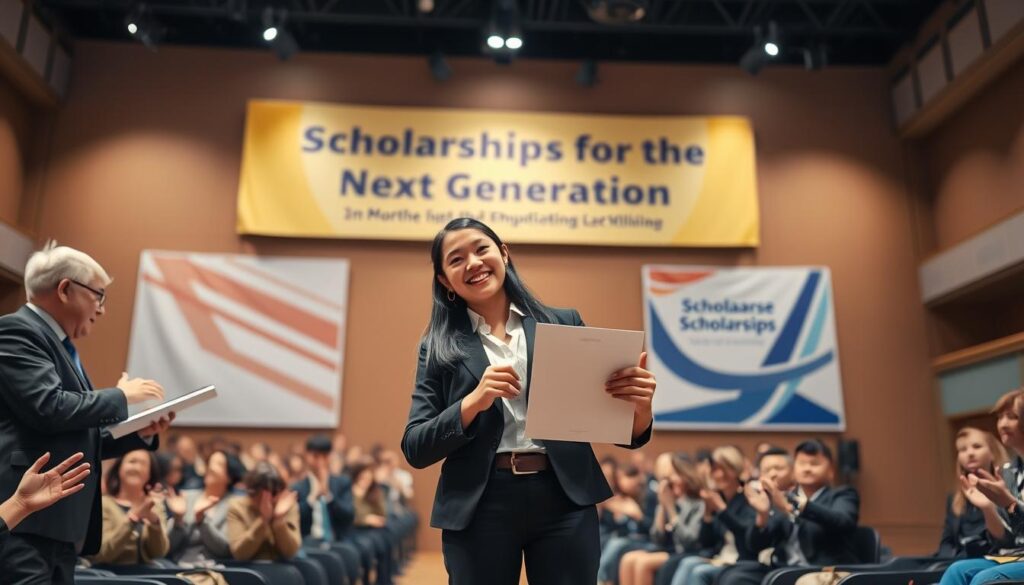
Forget what you think you know about scholarships. The game has changed. Today, student support is a high-stakes, strategic arena. It’s not about charity; it’s like venture capital for human talent.
Financial support for the next generation is evolving. It’s not just about grades or test scores. Modern awards look for your story, drive, and the problems you want to solve. Many places, for example, automatically consider all applicants for major awards. It’s not just about applying; it’s about how you position yourself.
This isn’t a boring lecture from your high school counselor. We’re diving into the modern scholarship world. It’s a strategic investment in human capital, not a handout.
Think of it as your seed funding round. You’re the startup. Your brilliant mind is the product. Let’s talk about how to pitch.
Program overview: purpose and award structure
Scholarships today are more than just money. They offer a chance to grow and lead in the future. The NRF Foundation Next Generation Scholarship is a great example. It’s not just about paying for school; it’s about finding and growing future leaders.
The top winner gets a $25,000 scholarship, and four finalists get $10,000 each. But the real value is in the connections and opportunities it brings. This program and others like it are like a VIP pass to a network of leaders.
The “Why”: More Than Just a Check
Modern scholarships are not just charity. They are investments in the future. The NRF’s scholarship looks for more than just good grades. It wants people who can think strategically and lead.
The application process is tough. It includes essays, videos, case studies, and interviews. It’s designed to find people who are creative, resilient, and can think strategically.
Investment, Not Charity
These scholarships are not just about giving money. They are about investing in people. The top prize is like seed money for a future leader.
The sponsor is not just giving money; it’s betting on a person’s success. This approach is what makes these scholarships different. For more on creating such programs, check out this scholarship manager’s guide.
The Prestige Quotient
The real value of these awards is the prestige they bring. Winning is not just a resume booster; it opens doors. The award structure, with one top winner and four finalists, creates a sense of competition.
Winners get more than just money. They get access to a network of leaders. The eligibility criteria look for more than just good grades. They want people who can think strategically and have a strong presence.
Eligibility & selection: criteria, scoring rubric, and the equity lens
The scholarship selection process is not just about grades. It’s a complex mix of criteria, rules, and a focus on equity. Your GPA is just the start, not the main focus.
Imagine applying for a scholarship as a video game. The “Eligibility” screen is like the tutorial. The scoring rubric and equity lens are the final challenges. The criteria you see are just the beginning. The real selection is based on your life’s experiences.
The Gatekeepers’ Checklist
Every scholarship committee has a secret checklist. They look for more than just good grades. They want to see your life experiences, like working and tutoring.
That part-time job you had? It shows your grit and real-world experience. It’s more important than a perfect GPA for someone who hasn’t faced challenges.
The Rubric: More Than Just a GPA
The rubric is where things get interesting. It’s not just a yes or no checklist. It’s a points system, like an Olympic diving competition.
A perfect GPA is like a triple somersault. But you need to attempt the dive. Your application is the dive.
| Scoring Category | Weight (Sample) | What They’re Really Looking For |
|---|---|---|
| Academic Merit (GPA, Test Scores) | 30-40% | Not just the number, but the trend. An upward trajectory from a C+ to an A- can tell a story of resilience that a perfect 4.0 from day one can’t. |
| Leadership & Initiative | 25-35% | Founding a club, starting a project, leading a team. They want doers, not just students. |
| Resilience & Context | 20-30% | Overcoming adversity, financial hardship, or significant personal challenges. This is where your personal statement makes or breaks you. |
| Community & Service | 15-20% | Not just a line on a resume. Did your service have impact? Did you show up for more than just the volunteer hours? |
A scholarship rubric is a points game. A perfect 4.0 might get you 40 points. But a student with a 3.5 who also started a campus food bank might score higher overall.
The “equity lens” is a big deal in funding. It’s about fairness and correcting past imbalances. Scholarships like the RTA2024 Masters funding for cancer research are examples.
This lens considers your background. A 3.5 GPA from someone who worked to support their family is more impressive than a 4.0 from someone with advantages. Programs are now scoring for context.
Is it a game-changer? For targeted scholarships, yes. They help specific groups. For general scholarships, it’s a tie-breaker. It’s not about lowering standards; it’s about expanding what “merit” means.
The real application tip? Show how your challenges made you stronger. That’s the new eligibility criteria for today’s scholar.
Application checklist: transcripts, essays, references, financial docs
This is where ambition meets bureaucracy. The application checklist is not just a to-do list; it’s a challenge. Each document you submit is a piece of your story, a showcase of who you are, not just a student. We’re moving beyond the to-do list and into the theater of self-presentation. Forget checking boxes; we’re building a case. This is your dossier.
The Paper Trail: Building Your Dossier
Think of this less as paperwork and more as your pre-game portfolio. Every document, from the most official transcript to the most casual letter, is a brushstroke in a larger self-portrait. The committee isn’t just checking for completion; they’re reading between the lines, looking for the story the documents tell together. Your goal isn’t to submit a perfect file, but a coherent and compelling one.

Your transcript is more than a GPA. It’s your intellectual fossil record. A committee doesn’t just see an “A” in Calculus; they see a pattern of rigor. They don’t just see a “B” in Freshman English; they see a trajectory. Did you overcome a shaky start? Did you challenge yourself with AP or IB courses? That upward trend in your “academic fossil record” tells a story of growth that a perfect, static 4.0 might not. This document isn’t a report card; it’s the geological record of your scholarly curiosity.
The Financial Snapshot: Proving Need Without Pleading Poverty
This is the most delicate piece of the puzzle. The goal is to demonstrate need with dignity and precision, not pathos. Submitting the FAFSA SAR, tax returns, or bank statements isn’t about proving you’re poor; it’s about presenting a clear, unvarnished financial snapshot. It’s not a sob story; it’s a financial statement. The committee isn’t looking for hardship points; they’re looking for data. Present your financial documents with the same clarity and organization as a business report. This isn’t about pleading poverty—it’s about proving need with the cold, hard data of a tax return.
Beyond the transcript and FAFSA lies the heart of your dossier: the qualitative evidence. This is where you move from a collection of grades and numbers to a three-dimensional person.
- The Personal Brand Video: This is not a TikTok. This is a 60-90 second elevator pitch in high-definition. It’s not about production value; it’s about clarity, authenticity, and showing a spark of the person behind the GPA. Talk to the camera, not at it. Show, don’t just tell.
- The Letter of Recommendation: This isn’t a formality. Choosing the right champion is key. The best recommenders are those who can speak to your character under pressure, your intellectual spark in a classroom, or your resilience in a crisis. Brief them. A bullet-pointed email with your resume and a key anecdote you hope they’ll mention can transform a generic “great student” letter into a powerful, specific endorsement.
- The Resume: This is your professional persona on paper. It should scream “doer,” not just “student.” Frame every bullet point as an action and an impact. Instead of “Member of Debate Club,” try “Researched and presented on policy arguments for 10+ weekly debates.” It’s the difference between a list and a legacy.
Think of the application not as a set of hoops to jump through, but as a curated exhibition of your talent. The checklist is just the framework. Your job is to fill it with a story that only you can tell.
Essay guidance: prompts, storytelling, originality, do’s and don’ts
You’ve got your transcripts and references ready. The forms are filled out. Now, it’s time for the essay. This isn’t a book report. It’s like a legal brief for your future.
The prompt is your case file. Your essay is the closing argument for your future. We’re not writing your autobiography. We’re crafting a story so compelling, the selection committee must choose you.
Beyond the Prompt: Finding Your Angle
Every prompt is a locked door. The key is finding the hidden door behind it. The prompt asks for a challenge you’ve overcome.
Everyone writes about sports injuries or tough exams. The winning applicant writes about overcoming that challenge. Describe the mountain you climbed, but also the crampons you invented to scale it.
What did you build to get over it? This is where your story begins.
The “So What?” Factor
Every paragraph, every anecdote, every claim must pass the “So What?” test. You organized a food drive? So what? You tutored a classmate? So what?
The “So What?” factor shows the impact of your actions. So what that you led the robotics team? So, you learned that leadership is about debugging team communication before a big competition.
The “So What?” turns a resume line into a story of growth. It’s the difference between “I built a robot” and “I learned that the most elegant engineering is useless without a shared vision.”
Originality vs. Authenticity
Forget being “original” in the “never-been-done-before” sense. It’s a myth. Authenticity is the new originality.
The selection committee has read many essays about “finding my voice” or “the day I discovered my passion for service.” They haven’t read about how your failed lemonade stand at age 10 taught you about supply chain logistics and customer psychology.
Authenticity is specificity. It’s the smell of burnt cookies in your grandmother’s kitchen, not just “baking with grandma.” It’s the specific line of code that broke, and the specific all-nighter that fixed it.
Don’t chase what you think is unique. Dive deep into what is uniquely, specifically, and undeniably you. Authenticity is magnetic; a manufactured “original” idea is a house of cards.
Do’s and Don’ts: The Strategic Checklist
Consider this your tactical field manual. This isn’t about platitudes; it’s about strategic choices that separate the shortlist from the slush pile.
| Do’s | Don’ts | Why It Matters |
|---|---|---|
| Hook with a scene, not a thesis. Start in the middle of the action. “The server room was 50 degrees and smelled of ozone and panic” is better than “I have always been passionate about computer science.” | Don’t start with a dictionary definition or a famous quote. The admissions officer has read enough essays that begin, “Webster’s defines ‘perseverance’ as…” | Grabs attention immediately and shows, not tells. It demonstrates narrative skill from the first line. |
| Show, don’t just tell. Instead of “I’m resilient,” show your car breaking down on the way to a critical debate, and how you MacGyvered a solution with a paperclip and a dream. | Don’t use clichés or generic statements. “I want to help people” is a platitude. “I want to apply fluid dynamics to design more efficient irrigation pumps for small farms” is a mission. | Specificity builds credibility and memorability. It proves your experience, not just stating a quality. |
| Answer the “So What?” relentlessly. For every achievement, ask: “What did I learn? How did it change me?” This is your intellectual and emotional ROI. | Don’t just list accomplishments. The resume lists the “what.” The essay explains the “why” and “how” behind one or two of them. | Transforms a brag sheet into a story of growth, which is what committees are actually looking for. |
| End with a “kicker.” Your conclusion should not summarize. It should look forward, connecting your past story to your future field of study or career in a way that feels inevitable. | Don’t introduce a brand new idea in the conclusion. The final paragraph is for synthesis, not surprise plot twists. | Creates a powerful, resonant finish that ties the narrative together and points toward the future. |
Remember, the essay is your chance to be a three-dimensional person, not just a GPA and test score. The judges aren’t just looking for the next valedictorian. They’re looking for the future innovator, the collaborator, the person whose unique perspective will change the campus—and eventually, the world.
They’re not just funding a student; they’re investing in a story that’s just getting to the good part. Make them believe in your next chapter.
Use these application tips to move beyond simply answering the prompt. Think of it as your closing argument. Your evidence is your experience. Your logic is your narrative. Your verdict? That scholarship.
Recommendation letters: who to ask and how to brief them
A great letter of recommendation is not just a character witness. It’s a strategic move to win over a selection committee. Your recommender is like your campaign manager, aiming to make you unforgettable. The goal is not to be liked but to be unforgettable.

One strong letter can change your application from “qualified” to “indispensable.” The wrong letter can be like showing up to a duel with a water pistol. It’s not about getting a signature; it’s about curating an advocate.
Choosing Your Champions
Don’t chase the biggest name on campus. The department chair or Nobel laureate might not be the best choice. Look for someone who can speak about you with specificity.
Choose someone who can tell a specific story about you. A generic letter from a big name is bad. But a detailed letter from a TA or supervisor can be powerful.
The Briefing: Equipping Your Advocate
Asking for a letter is not a simple email. It’s a detailed briefing. You need to prepare your recommender well. Make sure they remember your achievements.
Your briefing packet should include:
- The Dossier: Your updated CV, the scholarship criteria, and your top achievements.
- The Narrative: A brief story about you. Highlight your strengths and achievements.
- The “Do Not Say” List: A list of things you’d prefer they don’t mention. This helps focus the letter.
- The Logistics: The deadline, submission link, and a clear “submit by” date. This is your project manager’s guide.
The table below shows what to include in your “Recommender Briefing Packet.” This is not just busywork. It’s the key to a letter that praises you in a unique way.
| Packet Component | What to Include | Why It’s Critical |
|---|---|---|
| Your CV/Resume | A clean, updated version with relevant coursework, projects, and achievements highlighted. | Provides the recommender with a full picture of your background and saves them from having to recall or ask for details. |
| Scholarship & Program Info | The program description, its values, and the specific scholarship criteria. | Aligns the recommender’s narrative with the specific values and goals of the award. |
| Your “Greatest Hits” List | 2-3 bullet points on specific, impressive things you did that they witnessed. | Jogs their memory and provides concrete, positive anecdotes they can use as evidence. |
| Your Personal Statement | A copy of your personal statement or essay. | Ensures their letter complements and reinforces the story you’re telling, not contradicts it. |
| Submission Logistics | Clear instructions, deadlines, and a link or address. | Makes the process frictionless. A busy professor will thank you for this. |
The result of this briefing is not just a letter. It’s a targeted, specific, and powerful endorsement. It proves you’re exceptional, backed by evidence. This transforms a letter into a strategic asset. In the competitive world of scholarships, this is a key application tip: orchestrate your letter’s success.
Timeline: milestones, reminders, interview prep
Forget the simple to-do list. Winning a major scholarship is like a military campaign. Your timeline is the battle plan. It’s not just about checking boxes on a calendar; it’s about planning a multi-front campaign.
A single missed deadline can be a checkmate you can’t afford. This is a nine-month gauntlet of paperwork, persuasion, and patience. Let’s map the minefield.
The Strategic Calendar: Your Month-by-Month Campaign
Viewing the timeline as a series of discrete, one-off tasks is the first mistake. The process from opening bell to final curtain is a single, continuous, nine-month performance. The National Merit Scholarship timeline is a perfect case study in endurance and precision.
Let’s break down the NRF’s brutal, beautiful, and meticulously cruel timeline. This isn’t just a schedule; it’s your strategic calendar.
| Phase | Key Date | Milestone | Strategic Objective |
|---|---|---|---|
| Phase 1: The Opening Gambit | January 8 | Application Opens | Portal opens. Your campaign begins. Time to finalize your “Why.” |
| Phase 2: The First Cull | May 26 | Phase 1 Deadline | Essays, transcripts, and the initial data dump are due. This is the first major filter. |
| Phase 3: The Cut | June 24 | Semifinalists Announced | The pool narrows. If you’re here, your paperwork passed. Now, the real test begins. |
| Phase 4: The Deep Dive | August 10 | Phase 2 Deadline | In-depth project proposals, more essays. They’re testing for depth and resilience. |
| Phase 5: The Gauntlet | Sept 1-26 | Interviews | The crucible. A 30-minute interview that determines everything. Every word, pause, and gesture is data. |
| Phase 6: The Finalists | October 6 | Finalists Announced | The home stretch. The final review. |
| Phase 7: Victory Lap | January 2027 | Winner Announced | The campaign ends. The real work begins. |
The Hidden Timeline: Backward Planning from the Interview
This is the real game. Smart applicants don’t plan forward from the opening date; they plan backward from the interview. The interview isn’t the finale—it’s the entire third act of your play.
Your hidden timeline starts months before the application even opens:
- Recommendation Letters: You should have asked your champions yesterday. A last-minute request is a recipe for a generic, lifeless letter. Give your writers 6-8 weeks of lead time, minimum.
- Essay Drafts: The prompts are often similar year-to-year. Start drafting the moment last year’s winners are announced. The “hidden” work of introspection and storytelling happens now, not the week before the deadline.
- Video Prep: For programs requiring video submissions or interviews, your prep starts the day you decide to apply. Practice on camera. Record yourself. The “you” on screen is the product they’re buying.
Now, the NRF is just one battlefield. The savvy applicant runs a portfolio of applications. You’re not applying to one scholarship; you’re managing a portfolio of opportunities, each with its own deadlines and rhythms.
| Scholarship | Typical Deadline | Strategy Note |
|---|---|---|
| Helen Betty Osborne Memorial | January 23 | Early deadline. A common first “live fire” test for your application materials. |
| Loran Award | Early Fall (Rolling) | Extremely competitive. Requires a holistic, character-driven application. Start now. |
| Various University-Specific Awards | Rolling, Early, & Fixed Dates | Create a master spreadsheet. Color-code by deadline type (Rolling, Early, Fixed). Attack rolling deadlines first. |
Your strategic calendar isn’t a list of dates. It’s a dynamic map of deadlines, dependencies, and preparation windows. The countdown doesn’t start when the application opens. It started the day you decided you were a contender. Plan backward from your interview, and you’ll never be late.
After the award: mentorship, reporting, giving back as alumni
Winning a scholarship is just the start. The real work begins after the congratulations. You become a brand ambassador and a future donor. This is a long-term relationship, not just a single transaction.
The Obligations: More Than Just a Check
That scholarship check came with a social contract. It’s not just money; it’s an investment in your future. The foundation expects a return, not just in donations but in your success.
These obligations are often formal. You might need to send annual reports or maintain a certain GPA. For example, some awards require you to serve on a board, connecting you to the foundation’s inner workings.
The Network: Your New Rolodex
This is your new Rolodex, a valuable asset. It’s not just a LinkedIn connection. It’s a group of high-achievers who can help you in your career.
This network is a two-way street. It helps you, but you also help the foundation. Alumni often mentor new scholars and speak at events, helping the program’s legacy.
Paying it Forward: The Alumni Contract
The expectation is that you’ll give back. This “alumni contract” is not formal but is deeply felt. You’re expected to donate, mentor, or share your success story.
This creates a network of successful alumni who support the next generation. It’s both a gift and an investment in your future.
To understand the post-award landscape, it helps to see how different programs structure this long-term relationship.
| Program Type | Mentorship & Enrichment | Reporting & Accountability | Alumni Engagement Expectation |
|---|---|---|---|
| Elite Leadership Awards (e.g., Loran, Rhodes) | Structured mentorship, leadership summits, annual retreats, exclusive networking events. | Annual progress reports, GPA maintenance, participation in program events. | High. Strong alumni network, expected to mentor, speak, and donate. |
| STEM-Focused Awards (e.g., Schulich, Goldwater) | Research opportunities, lab access, conference funding, industry networking. | Academic progress reports, research updates, final project/thesis. | High in STEM fields; expected to contribute to field advancement. |
| Foundation/Corporate Awards (e.g., NRF, corporate named awards) | Varies. May include intern pairing, professional development workshops. | Financial need verification, academic standing, service hours. | Moderate. Often includes a “give back” clause, encouraging future support. |
| Need/Community-Based Awards | Often less formal, but may offer peer support groups. | Proof of enrollment, sometimes community service hours. | Varies. Often a “pay it forward” ethos. |
The table shows that prestigious awards are partnerships. The student support system turns into a professional and social contract. You’re not just a student; you’re a stakeholder in the foundation’s legacy. This relationship is designed to last a lifetime, ensuring the cycle of giving and mentorship continues.
FAQ & contact
You’ve got the strategy. You’ve prepped your dossier. Now, for the questions you’re too proud to ask in a crowded room.
The Usual Suspects (With Straight Answers)
“Can I apply if my GPA is 2.9?”
The official line is a 3.0. But life is rarely a clean integer. A 2.9 might be a red flag or a compelling story of resilience. The committee’s equity lens means they’ll look at the whole picture, but that 2.9 better be the only blemish on an else stellar, narrative-changing application. Don’t hide from it; explain it.
“Do I *really* need another letter of rec?”
Yes. The application asks for two. Asking for three is a test. A generic, lukewarm letter from a professor you barely know is like bringing a plastic spoon to a sword fight. It’s not about the quantity of stamps in your dossier, but the quality of the voice advocating for you.
“What are my chances?”
Asking that is like asking for the weather in six months. We don’t have a crystal ball. Your chances are exactly zero if you don’t apply. Obsessing over a statistical phantom is a distraction. Focus your energy on the factors you control: the essay, the recommendations, the story.
For questions the website and this guide haven’t answered, you can reach out to scholarships@nrf.com. But do your homework first. They’ve read all the FAQs, too.
The strategy is set. The clock is ticking. Your move.