
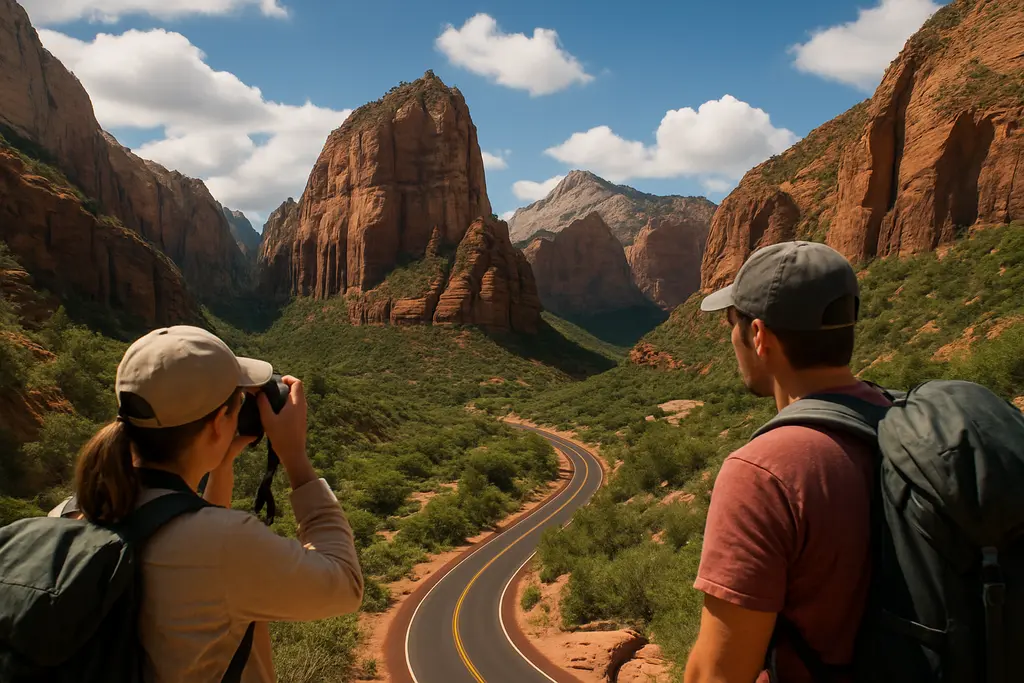
The Mount Carmel Highway closure situation in Zion National Park is not a single full-season shutdown. As of September 22, 2026, travelers are dealing with a mix of temporary nighttime tunnel work, standing large-vehicle limits, and normal weather or congestion-related road controls. I have learned on red-rock road trips that the most useful plan is not the prettiest map line; it is the route that still works after dark, after a storm, or after a vehicle measurement changes the answer at the gate.
Mount Carmel Highway Closure Status
Mount Carmel Highway Closure Timing
The Zion-Mount Carmel Highway remains open year-round, except when temporary closures are needed because of snow, ice, rockfall, or traffic congestion, according to the National Park Service Zion current conditions page. That distinction matters for trip planning. The road is not broadly closed for all visitors on September 22, 2026, but specific overnight windows are restricted because of tunnel work.
The park’s September 15, 2026, notice listed planned temporary nighttime closures for the Zion-Mt. Carmel Tunnel and Highway tied to a Utah Department of Transportation fiber optic installation project. The listed closure periods run from 9 p.m. to 6 a.m. on the nights of September 21-25 and September 28-30, 2026, between the East Entrance of the tunnel and Canyon Junction. Since September 21 has already passed as of today, travelers should treat the remaining listed nights as the dates to verify before relying on a late crossing.
Why The Road Still Matters
The Zion-Mount Carmel Highway is more than a scenic connector on a park map. The highway and its 1.1-mile tunnel were constructed between 1927 and 1930, dedicated on July 4, 1930, and the corridor is listed on the National Register of Historic Places. The climb to the tunnel gains about 800 feet, and the tunnel is about five miles from the Zion Canyon Visitor Center. That makes the Mount Carmel Highway closure issue both practical and preservation-related: the same historic engineering that makes the drive memorable also limits what the route can handle today.
Vehicle Limits And Tunnel Controls
Large Vehicle Cutoffs
Major restrictions for large vehicles took effect on June 7, 2026. Vehicles exceeding 11 feet 4 inches in height, 7 feet 10 inches in width, 35 feet 9 inches in length, or 50,000 pounds are prohibited from using the Zion-Mt. Carmel Highway from Canyon Junction to the East Entrance, based on the park’s published vehicle restriction plan. These are not casual advisory numbers. They are the figures travelers should compare against rental contracts, RV specifications, commercial tour vehicle dimensions, and loaded vehicle weight.
The stated purpose of the restrictions is to reduce collisions and structural damage. The road includes tight turns, steep grades, and road and tunnel sections not designed for very large, heavy, or tall modern vehicles. From a planning standpoint, the risk is not just being turned around. It is losing time on a day when lodging, activities, or group arrivals depend on a narrow arrival window.
What Escort Rules Mean
When large vehicle restrictions apply, one-way traffic control is often required through the tunnel. Some oversized vehicles may still cross under special escort or permit, typically during daytime hours only. That does not remove the need to check measurements in advance. I have watched group trips fall behind not because anyone ignored a closure, but because one rented vehicle was just outside the allowed size and the backup plan had not been discussed.
For travelers arriving by air and linking flights with a park road trip, the regional flight planning notes provided by resources such as Vision Airlines can help in organizing the airport-to-road portion. However, the crucial choice still revolves around the park’s current road rules and your vehicle dimensions.
Route Choices During Night Work
Alternate Drives To Price In
During the listed nighttime closures, travelers should use alternate routes. The research notes identify Utah Route 14 and the US 89 to AZ-389 to UT-59 option among the alternatives. The park notice stated that detours may add 10 to 45 minutes depending on the destination. A Mount Carmel Highway closure can therefore be minor for one driver and highly disruptive for another, especially if the day already includes a long desert drive.
The useful exercise is to test the route at the time you expect to drive, not at midday from a hotel lobby. A late arrival after 9 p.m. falls inside the listed closure window. A pre-dawn start before 6 a.m. does as well. If the group is split between vehicles, make sure each driver has the same alternate route written down before cell coverage or fatigue becomes part of the problem.
Group Planning Notes
Adventure gatherings in Zion often involve mixed vehicles: one family in a compact car, another in an RV, and a guide or shuttle driver managing gear. The 2026 rules make that mix less forgiving. A plan that works for the smallest vehicle may fail for the largest one. The practical answer is to sort vehicles by tunnel eligibility before the group chooses a meeting point or dinner reservation.
- Measure vehicle height, width, length, and loaded weight before relying on the tunnel route.
- Check whether any planned drive falls between 9 p.m. and 6 a.m. on the listed September closure nights.
- Build the 10 to 45 minute alternate-route range into arrival estimates.
- Recheck road status on the day of travel because weather, rockfall, construction, or congestion can change access.
What To Check Before Booking

Reservation Timing
The safest planning habit is to keep reservations flexible where the road is part of the arrival math. That does not mean avoiding Zion. It means avoiding a chain of tightly spaced commitments that assumes the tunnel will be available at the exact minute you want it. The fiber optic work listed for September 2026 is a scheduled project, but the park also identifies snow, ice, rockfall, and congestion as reasons temporary closures may be needed.
Travelers should check the National Park Service current conditions page and the UDOT Zion Area Roads to Recreation information before booking nonrefundable timing-dependent plans. The research notes state that closure dates, especially those tied to construction or weather, can change with little notice. That is not a reason to cancel a trip. It is a reason to keep the last hour of the drive honest.
Weather And Rockfall Caveats
Zion’s road status can shift for reasons that do not appear in a long-range travel plan. Snow and ice are seasonal concerns, while rockfall and traffic congestion can require temporary controls without fitting neatly into a visitor’s calendar. The practical response is simple: check the official status before leaving for the park, again before committing to the tunnel approach, and once more if a drive has been delayed into evening hours.
This is where cautious planning improves the trip rather than dulling it. The highway is historic, steep, and visually striking, but those same traits place limits on modern traffic. The road was not built for every vehicle type now common in national park travel. Treating those limits as part of the experience keeps the day focused on the canyon rather than a preventable turnaround.
Mount Carmel Highway Trip Decisions
After my own red-rock drives, I treat a Mount Carmel Highway closure as a timing and vehicle problem first, not a reason to write off the route. If your vehicle is under the June 7, 2026, limits and your drive is outside the listed 9 p.m. to 6 a.m. work windows, the highway may still fit the plan, subject to current conditions. If you are driving a large RV, a commercial vehicle, or any vehicle close to the posted measurements, build the alternate route into the plan before arrival.
For September 22, 2026, the key traveler takeaways are specific: verify the remaining September nighttime closure dates, confirm vehicle dimensions against the 2026 restrictions, and avoid assuming that a historic tunnel can handle every modern travel setup. Zion rewards flexible drivers. The better plan is the one that can absorb a detour and still leave room for the gathering you came to share.