
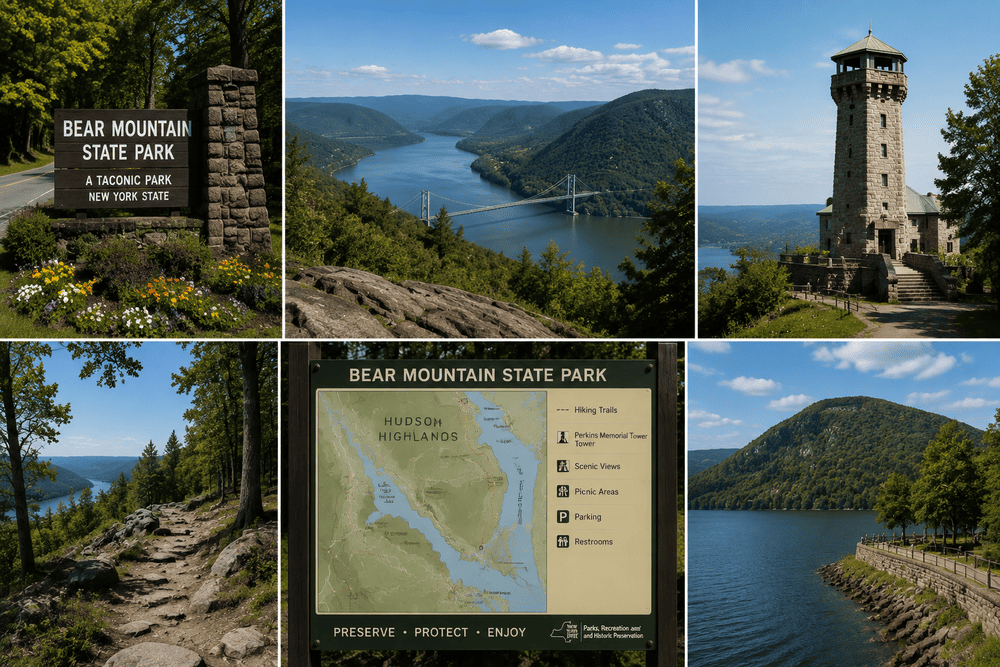
The physical reality of Bear Mountain State Park operates as a massive geological and recreational anchor in the lower Hudson Valley. Situated on the west bank of the Hudson River in Rockland and Orange counties, this 5,205-acre park defines the steep, forested terrain of the region just forty-five miles north of New York City. The Palisades Interstate Park Commission established the reserve in 1910 following a massive public campaign to stop private commercial quarrying operations from detonating the mountain ridges. Evaluating its hard rock geology, the historical integration of the Appalachian Trail, and the heavy physical infrastructure provides a clear framework for analyzing one of the most heavily trafficked natural spaces in the American Northeast.

Geological Formation And Topographical Realities
The park rests on a complex foundation of Precambrian rock. Geologists trace the origins of these particular mountains back over a billion years to the Grenville orogeny. The exposed rock faces consist primarily of heavy granite and banded gneiss, materials highly resistant to mechanical erosion. This structural durability explains the dramatic verticality of the terrain. The mountain summits rise sharply from the sea-level tidal estuary of the Hudson River, creating severe elevation gradients in a very short horizontal distance.
Glacial activity shaped the modern surface features of the park. Massive ice sheets advanced and retreated across this region during the last ice age, scouring the granite ridges and depositing massive erratic boulders across the forest floor. The ice carved deep U-shaped valleys between the peaks. The steep ravines now funnel heavy seasonal rainfall directly into the local watersheds. The rugged nature of this terrain historically prevented large-scale agricultural development, preserving the dense hardwood forests of oak, hickory, and maple that cover the slopes today.
The Appalachian Trail Integration
Bear Mountain State Park holds a highly distinct status in the history of American outdoor recreation. The very first section of the Appalachian Trail opened here in 1923. Planners mapped the initial route starting from the park boundaries, pushing southward into the deeper wilderness of Harriman State Park. Today, the trail cuts straight through the center of the facility, functioning as a primary artery for both day hikers and long-distance backpackers walking the 2,190-mile route from Georgia to Maine.
The trail crosses the Hudson River via the Bear Mountain Bridge and immediately drops to the lowest elevation point on the entire Appalachian Trail network at just 124 feet above sea level. From this low point, hikers face a grueling vertical ascent straight up the eastern face of Bear Mountain. State park crews completely rebuilt this exact trail section over the last decade, installing hundreds of massive granite steps cut directly from the mountain. This heavy masonry stabilizes the slope against severe human foot traffic and channels rainwater safely down the mountain to prevent catastrophic soil erosion.
The trail runs directly through the Trailside Museums and Zoo. This facility operates as a localized rehabilitation center for native New York wildlife. Black bears, eastern coyotes, and bald eagles that cannot return to the wild live in naturalized enclosures built directly into the bedrock. This routing forces hikers to pass through an educational corridor before reaching the true wilderness of the high ridges.

Hessian Lake And Recreational Infrastructure
The center of the lower park revolves around Hessian Lake. The water occupies a deep glacial depression right at the base of the mountain. Local historical records indicate the water body originally carried the name “Bloody Lake.” During the Revolutionary War, the British forces executed a successful assault on nearby Forts Clinton and Montgomery in 1777. The retreating American forces reportedly threw the bodies of fallen Hessian mercenaries into the water, generating the grim historical moniker that eventually softened into its current name.
The modern lake operates entirely as a recreational asset. The state completely prohibits swimming to protect the water quality, directing visitors to a massive outdoor municipal pool built nearby. Visitors rent rowboats and paddleboats to access the center of the lake. A flat, paved walking path surrounds the entire perimeter, providing immediate ADA-accessible transit for families and casual walkers. The heavy infrastructure surrounding the lake absorbs the highest concentration of daily visitors, effectively preventing the fragile upper mountain trails from collapsing under the massive human volume.
| Trail Designation | Blaze Color | Primary Destination | Physical Demand |
| Appalachian Trail | White | Summit of Bear Mountain | High |
| Major Welch Trail | Red Cross on White | Perkins Memorial Tower | High |
| Hessian Lake Loop | Paved/Unblazed | Perimeter of Hessian Lake | Low |
| Suffern-Bear Mountain | Yellow | Southern park boundary | Extreme |
Perkins Memorial Tower And Summit Access
The summit of Bear Mountain reaches 1,283 feet in elevation. The peak features the Perkins Memorial Tower, a heavy stone observatory built in 1934 by the Civilian Conservation Corps (CCC). The structure honors George W. Perkins, the first president of the Palisades Interstate Park Commission, who secured the massive private donations required to purchase the initial parklands.
The tower architecture mirrors the rugged nature of the mountain. The CCC laborers utilized rough-hewn local granite and massive timber beams to construct a facility capable of withstanding the severe wind loads and winter ice storms that batter the exposed summit. Visitors who climb the interior wooden staircases reach an observation deck featuring 360-degree sightlines. The view extends north up the Hudson River toward Newburgh, south toward the distant skyline of Manhattan on clear days, and west across the massive, unbroken canopy of Harriman State Park.
Accessing the tower requires severe physical exertion via the Appalachian or Major Welch trails, or utilizing Perkins Memorial Drive. This twisting, two-lane asphalt road winds up the backside of the mountain, providing direct vehicular access to the summit. The state closes this road during the winter months, handing the peak entirely back to wilderness hikers until the spring thaw.
Architectural Heritage: The Bear Mountain Inn
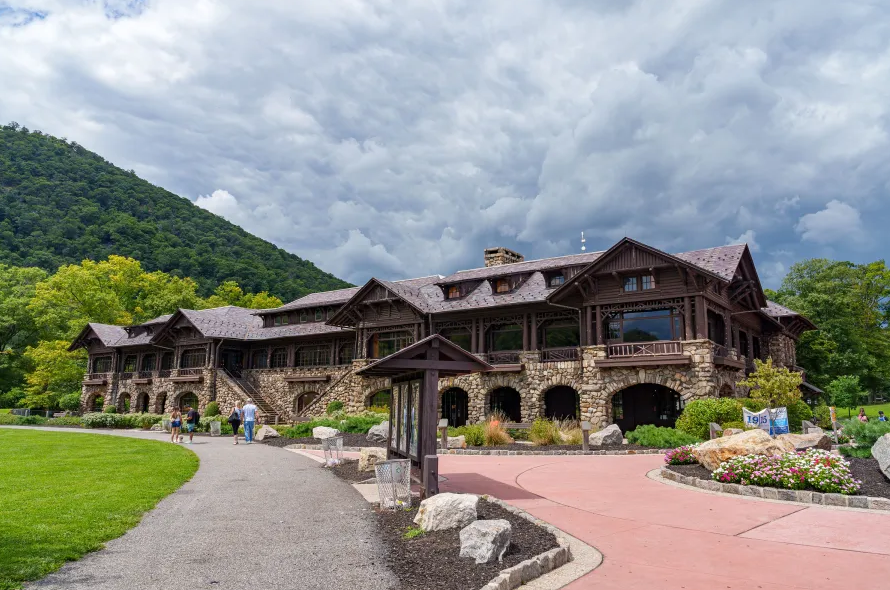
The primary commercial operation within the park centers on the Bear Mountain Inn. Completed in 1915, this massive structure represents one of the finest surviving examples of the Adirondack rustic architectural style in the lower Hudson Valley. The original builders sought to create a facility that felt organically connected to the surrounding geology.
The base of the building consists of massive, unpolished fieldstones pulled directly from the local hillsides. Heavy chestnut timbers support the upper floors and the sweeping, low-angled roofline. The initial operational model offered no overnight accommodations, functioning instead as an open-air restaurant and rest station for passengers arriving via massive steamboats from New York City. The management enclosed the structure in later decades, adding luxury hotel rooms and massive dining halls. The facility underwent a massive, multi-million dollar renovation in the 2010s to modernize the internal electrical and plumbing systems without altering the protected historical facade.
Ecological Management And Regional Logistics
Managing a wilderness area located under fifty miles from the largest metropolitan center in the United States requires severe logistical planning. The park frequently hits absolute maximum capacity during the autumn foliage season. The New York State Police and local park rangers actively close the primary entrances along US Route 9W and the Palisades Interstate Parkway once the massive parking lots fill. This aggressive crowd control prevents gridlock on the state highways and protects the physical trails from destructive over-saturation.
The local ecosystem supports a massive population of black bears, white-tailed deer, and wild turkeys. The intense volume of human visitors creates a continuous risk of wildlife habituation. The park enforces strict regulations regarding food storage and garbage disposal. Maintenance crews operate heavy-duty, bear-proof trash receptacles across the entire picnic grounds, actively preventing the local apex predators from associating the human crowds with an easy food source.
Travelers mapping out complex U.S. travel itineraries frequently use Bear Mountain as a primary staging ground before pushing further north into the Catskills or the Adirondacks. The immediate proximity to the highway network allows for high-speed transit directly out of the city. To verify current trail closures, seasonal road conditions, and parking capacities, visitors rely on the live updates provided by the official New York State Parks administrative directory. The facility stands as a highly engineered natural reserve, balancing the massive recreational demands of the public with the permanent geological realities of the Hudson Highlands.